
What is an AESA Antenna? Guide & Benefits
Advertisement
An Active Electronically Scanned Array (AESA) is a highly advanced, flat panel phased array antenna that steers radio frequency beams electronically without any moving physical parts. Instead of utilizing a rotating mechanical dish, an AESA relies on a grid of thousands of microscopic, stationary antenna elements each equipped with its own integrated transmitter and receiver module to instantly shape, steer and split multiple independent signal beams across the sky in a matter of microseconds. Let us explore AESA Antenna in more depth.
Introduction : For decades, the classic image of a satellite dish or radar system was a massive, curved parabolic bowl spinning on a mechanical pedestal. To track a moving object in the sky, physical motors had to rotate the entire heavy structure. This mechanical movement was slow, prone to hardware failure, and could only track one target at a time. The Active Electronically Scanned Array (AESA) fundamentally changed this.
An AESA is a flat panel antenna that can steer radio frequency (RF) beams in any direction instantly, without a single moving physical part.
Originally developed for advanced military fighter jets and missile defense systems, AESA technology is now the driving force behind modern 5G networks, Wi-Fi and Low Earth Orbit (LEO) satellite internet industry.
How an AESA Works
Instead of using one giant reflecting dish, an AESA is made up of a grid of dozens, hundreds or even thousands of microscopic, stationary antenna elements (i.e. radiators) arranged on flat circuit board.
To create a beam, an AESA relies on a principle called constructive and destructive interference.
- The system sends an RF signal to all the tiny antenna elements.
- Behind each element is an integrated circuit (IC) that slightly delays the signal’s release. This is called a “phase shift.”
- By mathematically timing exactly when the wave leaves each element, the waves collide in the air. In the desired direction, the waves combine and amplify each other (i.e. constructive interference) to form a tight, powerful beam. In all other directions, the waves cancel each other out (i.e. destructive interference).
To steer the beam from left to right, the antenna doesn’t move. The computer simply changes the delay (consequetively phase shift) at each element, and the beam instantly sweeps across the sky.
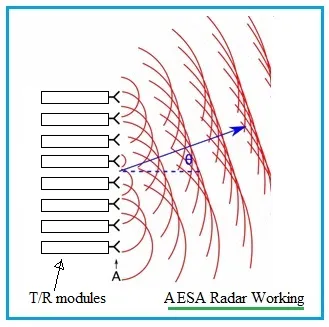 AESA Radar working
Key Advantages of AESA Technology
The shift from mechanical dishes to AESA panels unlocks several massive advantages for SATCOM and wireless networks.
- AESA can move its beam from one horizon to the other in a matter of microseconds.
- AESA can split its grid to form multiple independent beams at the exact same time. Hence single AESA panel can track a satellite setting in the west while simultaneously connecting to a new satellite rising in the east, ensuring an internet connection never drops during a handover.
- If the motor breaks on a mechanical dish, the whole system is dead. In an AESA, there is no single point of failure. As power is distributed across many active elements, the antenna will operate without any noticeable performance drop even after failure of few chips.
- Because an AESA has total control over the shape of its RF energy, it can intentionally create “blind spots” (known as nulls) in its reception pattern. If a hostile jammer or a noisy neighboring satellite is blasting interference at the antenna, the AESA can place a deep electronic null directly over the threat, effectively silencing it while maintaining a perfect connection to its desired target.
- Without bulky motors and pedestals, AESA antennas can be manufactured as flat, low profile panels. This makes them ideal for mounting flush against the fuselage of airplanes, the roofs of connected cars or the sides of naval ships without creating aerodynamic drag.
Summary
An Active Electronically Scanned Array (AESA) represents the pinnacle of modern antenna engineering. By replacing slow, mechanical hardware with thousands of active, software controlled micro-antennas, AESAs provide the speed, reliability and multi-tracking capabilities required to make next generation LEO satellite internet and ultra fast 5G communications a reality.
Continue Learning AESA and PESA
Compare Satellite Communication With Other Types
- Active Satellite Vs. Passive Satellite
- Satellite Communication Vs. Mobile Communication
- Geosynchronous Satellite Vs GeoStationary Satellite Orbit
- VLEO Vs LEO Satellite
Continue Learning Satellite Communication Technology
- Satellite Communication Basics Tutorial
- GEO Vs. LEO Vs. MEO Satellite Types
- Apogee and Perigee in Satellite Communication
- Satellite Capacity Allocation Types
- Satellite Frequency Bands
- Satellite Transponder Components & its function
- Satellite Bus vs Payload : Understand functions
- Satellite Ground Station Basics
- Satellite System Security Mechanisms & Standards
- Satellite Parking Lot Concepts and Procedures
- Satellite Launching Procedure and Processes
- Telemetry, Tracking and Command (TTC) in Satellite System