
8-PSK Modulation: Understanding Multilevel Phase Shift Keying
Advertisement
This page describes 8-PSK modulation basics, also known as multilevel PSK modulation. This is a type of digital modulation where the carrier’s phase is changed to represent digital data. In Phase Shift Keying (PSK) modulation, the phase of the carrier signal is altered according to the digital input.
It’s a digital modulation technique used in various applications, including broadcast video, aircraft, and satellite systems. We can achieve better bandwidth efficiency by mapping more than one bit to each signal element.
In Binary Phase Shift Keying (BPSK), digital data (1s and 0s) is represented by a 180-degree phase change.
In Quadrature Phase Shift Keying (QPSK), a phase shift of 90 degrees is used, mapping 2 bits onto each signal.
Multilevel PSK takes this further by mapping more than 2 bits using different phase angles. For instance, in 8-PSK, eight different phase angles are used, representing 3 bits.
The figure below shows a constellation diagram of an 8-PSK signal.
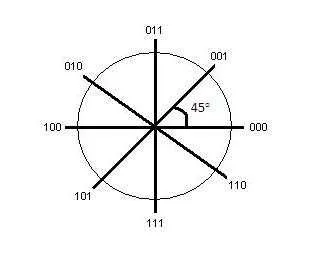
Fig. 8-PSK modulation technique
Continue Learning Modulation Types
- AM Vs. FM Vs. PM : Difference between Analog Modulation Techniques
- ASK Vs. FSK Vs. PSK : Difference between Digital Modulation Techniques
- PAM Vs. PWM Vs. PPM : Difference between Pulse Modulation Techniques
- BPSK Vs. QPSK : Key Differences
- 16-QAM Vs. 64-QAM Vs. 256-QAM : Key Differences
- 512-QAM Vs. 1024-QAM Vs. 2048-QAM Vs. 4096-QAM
- 4096QAM Modulation Used in Wi-Fi 7
- MSK Vs. GMSK : Modulation Technique used in GSM
- LORa Modulation Used in LoRaWAN
- 10% ASK & 100% ASK Modulation used in NFC
- OOK Vs. VPPM Vs. CSK : Visible Light Communication (VLC) Modulation Techniques
- QPSK Vs. OQPSK Vs. PI/4 QPSK
- PAM4 Modulation Used in Gigabit Ethernet
- CCK Vs. DSSS Vs. OFDM Used in WLAN (Wi-Fi) Standards