
AWGN Impairment Simulation in MATLAB
By RF Wireless Expert Team
Advertisement
This article provides MATLAB source code demonstrating Additive White Gaussian Noise (AWGN) impairment and its effect on constellation diagrams.
PART A: Generating a Complex Vector
This section generates a complex vector representing the modulated signal.
clc;
clear all;
close all;

len=input('Enter the length of the payload:');
mod=input('Enter 1 for bpsk, 2 for qpsk, 4 for 16qam, 6 for 64qam:(default:4)');

if mod==1
    c1=sqrt(1);
elseif mod==2
    c1=sqrt(1/2);
elseif mod==4
    c1=sqrt(1/10);
elseif mod==6
    c1=sqrt(1/42);
else
    printf('wrong entry');
end

%This part will generate binary vector as per length entered by user
data=floor(rand(1,len)+0.5);

%Mapping of binary data
mapper_out=data_mapping(data',mod,c1);
mapper_out_ori=mapper_out;

figure;
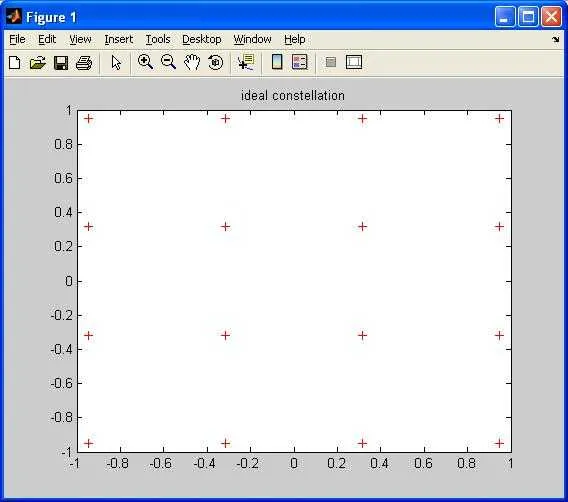
plot(real(mapper_out_ori),imag(mapper_out_ori),'r+');
title('ideal constellation');


## PART B: AWGN Impairment Addition

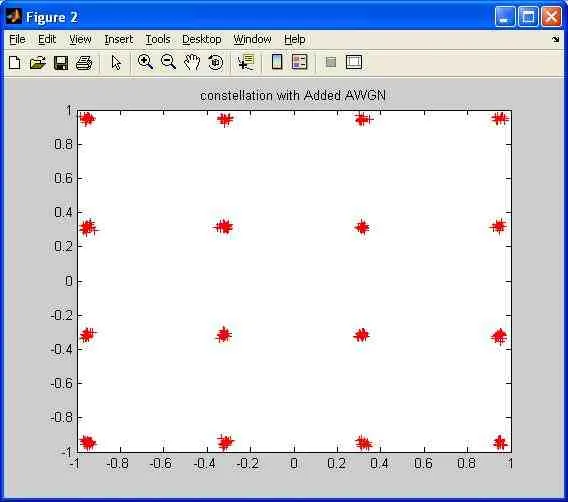
This section adds AWGN to the generated signal and displays the resulting constellation diagram.

```matlab
%AWGN impairment addition
snr=input('Enter SNR:');
map_out_awgn=awgn(mapper_out,snr,'measured');

figure;
plot(real(map_out_awgn),imag(map_out_awgn),'r+');
title('constellation with Added AWGN');
PART C: data_mapping.m Function
This is the code for the data_mapping.m function, which performs the digital modulation.
function [map_out]=data_mapping(data,mode,fact)

input_seq = data;

switch mode
    case 1
        b=fact*[1 -1];
    case 2
        b=fact*[1+1i -1+1i 1-1i -1-1i];
    case 4
        b=fact*[1+1i 1+3i 1-1i 1-3i 3+1i 3+3i 3-1i 3-3i -1+1i -1+3i -1-1i -1-3i -3+1i -3+3i -3-1i -3-3i];
    case 6
        b=fact*[3+3i 3+1i 3+5i 3+7i 3-3i 3-1i 3-5i 3-7i 1+3i 1+1i 1+5i 1+7i 1-3i 1-1i 1-5i 1-7i 5+3i 5+1i 5+5i 5+7i 5-3i 5-1i 5-5i 5-7i 7+3i 7+1i 7+5i 7+7i 7-3i 7-1i 7-5i 7-7i -3+3i -3+1i -3+5i -3+7i -3-3i -3-1i -3-5i -3-7i -1+3i -1+1i -1+5i -1+7i -1-3i -1-1i -1-5i -1-7i -5+3i -5+1i -5+5i -5+7i -5-3i -5-1i -5-5i -5-7i -7+3i -7+1i -7+5i -7+7i -7-3i -7-1i -7-5i -7-7i];
    otherwise
        error('wrong choice');
end

count=1;
count1=1 ;

for i=1:(ceil(length(input_seq)/mode))
    temp=0;
    for j=1:mode
        temp=bitor(temp,bitshift(input_seq(count),(j-1)));
        count=count+1;
        if(count>length(input_seq))
            break;
        end
    end
    map_out(count1)=b(temp+1);
    count1=count1+1;
end
Input Parameters
Example of input parameters used in the MATLAB code:
>> Enter the length of the payload:1000
>> Enter 1 for bpsk, 2 for qpsk, 4 for 16qam, 6 for 64qam:(default:4): 4
>> Enter SNR: 30
Input and Output Constellation Diagrams
Here are the constellation diagrams generated by the code, illustrating the impact of AWGN:
Explore MATLAB Channel Modeling & Impairments
- Rayleigh Channel Model in MATLAB
- Rician Channel Model Simulation in MATLAB
- Channel Model Impairments in MATLAB
- AWGN Impairment Simulation in MATLAB
- Carrier Frequency Offset Impairment in MATLAB
- MATLAB Sampling Frequency Offset Impairment
- MATLAB Phase Noise Impairment
- IQ Imbalance Impairment in MATLAB
- Simulating DC Offset Impairment in MATLAB
- Power Amplifier Nonlinearity Impairment in MATLAB
- CCDF (MATLAB Code)