
AESA Radar Range Calculator & Formula
Advertisement
This online AESA Radar Range Calculator allows you to compute the maximum detection range of an Active Electronically Scanned Array (AESA) radar system based on essential parameters such as transmit power, antenna gain, radar cross section, and more. Simply input the required values, and the calculator will provide you with the maximum range at which the radar can effectively detect targets.
AESA Radar Range Calculator
Example Calculation:
Scenario : Design a fighter jet Fire Control Radar (X-Band) using AESA technology. We need to calculate the maximum detection range for a fighter-sized target.
INPUTS:
-
Number of Transmit/Receive Modules (N) = 1000
-
Transmit Power per Module (Ptr) = 10 watts
-
Antenna Gain per Module (Ge) = 35 dB
-
Radar Cross Section (Sigma) = 3 m²
-
Operating Frequency = 10 GHz
-
System Sensitivity (Smin) = 2 x 10^-13 watts
Constant:
-
Speed of Light (c) = 3 x 10^8 meters/second
OUTPUT:
-
Wavelength (λ) = 0.03 meters
-
Total Transmit Power (Pt) = 10,000 watts
-
Total Antenna Gain (G) = 34.96 dB
-
Range in meters = 28,618 meters
-
Range in kilometers = 28.618 kilometers
AESA Radar Maximum Range Formula
Maximum radar range of AESA radar can also be calculated using the following radar equation:
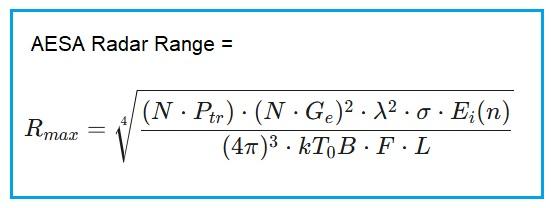
Where:
- R = Range to target (meters)
- N = Number of Transmit/Receive Modules
- Ptr = Transmit Power per Module (watts)
- Ge = Antenna Gain per Module (unitless)
- σ = Radar Cross Section (m²)
- λ = Wavelength (meters)
- 4π = Constant (approximately 12.566)
- k = Boltzmann’s Constant (1.38 x 10^-23 J/K)
- T = System Temperature (Kelvin)
- B = Receiver Bandwidth (Hertz)
- F = Receiver Noise Figure (unitless)
- L = System Losses (unitless)
- Ei(n) = Minimum Detectable Signal-to-Noise Ratio (unitless)
References
- Introduction to Airborne Radar. 3rd Edition. By Stimson, George W. Stimson’s
- Frontiers in Antennas: Next Generation Design & Engineering. By Parker, David. McGraw Hill, 2011
- Principles of Modern Radar: Advanced Techniques. SciTech Publishing, 2012. By Melvin, William A. & Scheer, James A.
Advertisement


