
Machine Learning in SATCOM: Top Use Cases
Advertisement
Introduction : Historically, satellite communications operated on highly predictable, static parameters. Geostationary (GEO) satellites sat in fixed positions, beams were pointed at designated ground stations and network resources were allocated based on rigid schedules.
Today, the SATCOM landscape is infinitely more chaotic. The rise of Low Earth Orbit (LEO) mega constellations (like Starlink, OneWeb and Kuiper) means thousands of satellites are flying overhead at 17,000 miles per hour. Terminals must constantly track moving targets, hand off connections every few minutes, dodge space debris and fight through dense radio frequency (RF) interference.
Human operators and traditional, hard coded algorithms can no longer manage this level of complexity. To keep these networks running efficiently, the aerospace industry is turning to Machine Learning (ML) and Artificial Intelligence (AI). Following are the primary use cases for ML in modern SATCOM networks.
1. Dynamic RF Link Budget Optimization
In any wireless system, the “link budget” is the calculation of all the gains and losses a signal experiences from the transmitter to the receiver. In LEO networks, this link budget changes by the millisecond due to satellite motion, atmospheric conditions (like rain fade) and network congestion.
How ML helps:
Engineers are deploying ML algorithms to move away from reactive systems to predictive and adaptive systems.
- Supervised Learning is used to analyze historical weather and signal data to predict future signal degradation and path loss.
- Reinforcement Learning allows the network to make real time decisions on the fly regarding power control, bandwidth allocation and satellite handovers.
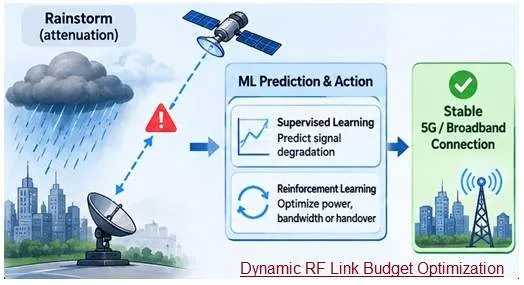
Real World Example: Imagine a massive rainstorm moving over a city. A traditional system might wait until the signal drops to unacceptable levels before reacting. An ML-driven system, however, detects the early signs of atmospheric attenuation, predicts the severity based on historical data, and proactively boosts the transmit power of the satellite or seamlessly re-routes the traffic to a neighboring satellite with a clearer line of sight before the user ever experiences a drop in their 5G or broadband connection.
2. Phased Array Antenna Calibration and Drift Compensation
Active Electronically Scanned Array (AESA) antennas use hundreds of tiny elements to electronically steer beams. To work correctly, the amplitude and phase of every element must be perfectly calibrated. However, AESA antennas are exposed to harsh environments. Searing heat, freezing cold, mechanical stress and component aging cause the hardware to experience “calibration drift,” which degrades beam accuracy and signal strength.
How ML helps:
Instead of requiring expensive, time consuming manual recalibration, ML acts as a “supervisory layer” running in the background of the antenna’s digital processor. The ML model learns how the specific antenna hardware behaves under different thermal variations and operating states over time.
Real World Example: An ML algorithm inside a satellite terminal mounted on an airplane wing notices that whenever the outside temperature drops below -30 degreeC, certain RF chips perform slightly slower. Anticipating this “drift,” the ML model automatically updates the digital correction coefficients, dynamically compensating for the temperature change. The antenna maintains pristine, digital grade beam performance throughout the flight without any hardware upgrades or offline maintenance.
3. Interference Detection and Spatial Nulling
As the RF spectrum becomes more congested and as intentional signal jamming becomes more common in defense and commercial sectors; satellite terminals must be able to protect their data streams.
How ML helps:
Advanced ML techniques are used for “Direction of Arrival (DoA)” estimation and spatial spectrum analysis. Even in environments with a terrible Signal to Noise Ratio (SNR), ML algorithms are exceptional at recognizing patterns. They can quickly identify the “fingerprint” of an interfering signal, classify it (e.g. adjacent satellite spillover vs. malicious jammer), and pinpoint its exact location in the sky.
Real World Example: A naval ship’s satellite terminal is subjected to intentional jamming. The ML-assisted DoA algorithm instantly localizes the threat’s angle of approach. It then directs the phased array to apply a “spatial null”; essentially creating an electronic blind spot exactly over the jammer; while keeping the main beam perfectly locked onto the friendly communications satellite.
4. Autonomous Spacecraft Operations & Collision Avoidance
With tens of thousands of new satellites entering orbit, ground control stations simply cannot micromanage the flight path and health of every single spacecraft.
How ML helps:
Satellites are increasingly being equipped with onboard AI and advanced processing modules to handle mission critical functions autonomously. This reduces the telemetry burden on the ground segment and allows the satellite to react to threats in milliseconds rather than waiting for instructions from Earth.
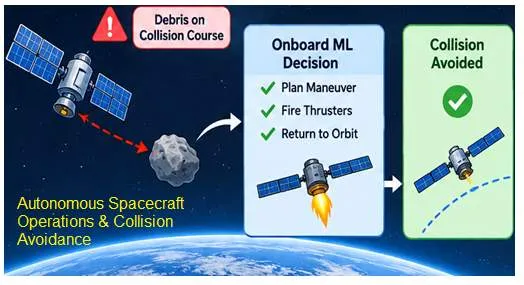
Real World Example (Space Traffic Management): An onboard ML system continuously processes radar and optical sensor data regarding Space Situational Awareness (SSA). It detects that a 5-centimeter piece of space debris is on a high-probability collision course with the satellite. Instead of waiting for a human engineer in a control room to calculate the physics, the onboard AI determines the optimal avoidance maneuver, fires the advanced propulsion thrusters to dodge the debris, and then automatically returns the satellite to its proper orbital station all autonomously.
Summary
Machine Learning is transitioning SATCOM from a rigid, hardware limited industry into a dynamic, software defined ecosystem. By utilizing ML for predictive link optimization, automated hardware calibration, cognitive interference dodging and autonomous flight safety, satellite networks are achieving unprecedented levels of efficiency, scale and resilience.
Compare Satellite Communication With Other Types
- Active Satellite Vs. Passive Satellite
- Satellite Communication Vs. Mobile Communication
- Geosynchronous Satellite Vs GeoStationary Satellite Orbit
- VLEO Vs LEO Satellite
Continue Learning Satellite Communication Technology
- Satellite Communication Basics Tutorial
- GEO Vs. LEO Vs. MEO Satellite Types
- Apogee and Perigee in Satellite Communication
- Satellite Capacity Allocation Types
- Satellite Frequency Bands
- Satellite Transponder Components & its function
- Satellite Bus vs Payload : Understand functions
- Satellite Ground Station Basics
- Satellite System Security Mechanisms & Standards
- Satellite Parking Lot Concepts and Procedures
- Satellite Launching Procedure and Processes
- Telemetry, Tracking and Command (TTC) in Satellite System