
5 Top 6G IoT Applications: How They Work & Key Features
Advertisement
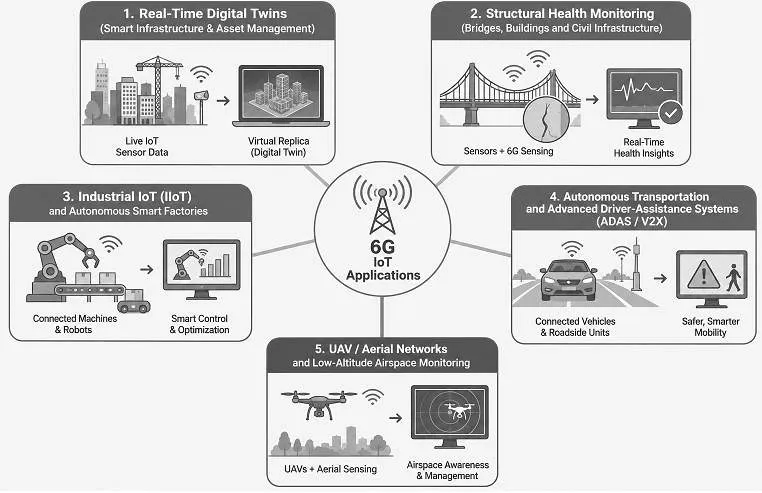
The five most transformative 6G IoT applications are Real Time Digital Twins, Structural Health Monitoring (SHM), Autonomous Smart Factories (IIoT), Connected Transportation & ADAS (V2X) and UAV & Low Altitude Airspace Monitoring. Unlike earlier IoT networks limited to basic telemetry, these systems combine dense sensor uplinks with real time radio wave reflections to sense, model and control physical environments instantaneously. All these applications are powered by unique 6G capabilities including mmWave/sub-THz bandwidth, sub-millisecond latency, multistatic ISAC, Reconfigurable Intelligent Surfaces (RIS), AI-assisted beamforming and Non-Terrestrial Network (NTN) convergence.
1. Real Time Digital Twins (Smart Infrastructure & Asset Management)
A digital twin is a live, continuously updated virtual replica of a physical environment such as a power grid, city district or manufacturing plant. Dense arrays of embedded IoT sensors, combined with wireless network sensing nodes, continuously stream real time telemetry, 3D spatial geometry and environmental states over the uplink to edge and cloud computing engines.
AI models run simulations on the virtual model to forecast equipment wear, test operational changes and send automated optimization commands back to the physical assets. Following 6G unique features make it possible to implement this use case.
- Ultra Wide Bandwidth (mmWave & Sub-THz): Accommodates massive, continuous uplink data streams from thousands of high resolution sensors and cameras simultaneously.
- Near Zero (Sub Millisecond) Latency: Keeps the virtual replica tightly synchronized with real world events so corrective actions occur instantaneously.
- Converged Computation & Native AI: Embeds edge intelligence directly into the network fabric to process sensor fusion and anomaly detection close to the physical asset.
2. Structural Health Monitoring (Bridges, Buildings, and Civil Infrastructure)
To monitor bridges, tunnels, skyscrapers and dams for structural fatigue, cracks or dangerous vibrations, 6G IoT pairs low power embedded strain/tilt sensors with non contact radio frequency sensing. Millimeter wave and sub-terahertz signals emitted by nearby 6G transceivers reflect off structural surfaces; by analyzing microscopic phase shifts, time delays and Doppler variations in the returned signals, the system detects millimeter scale displacement, material degradation or resonance shifts over time without requiring dense wired cabling. The figure below depicts 5 applications of 6G IoT.
3. Industrial IoT (IIoT) and Autonomous Smart Factories
Inside a smart factory, autonomous mobile robots (AMRs), robotic assembly arms, automated inspection cameras and environmental monitors operate as a synchronized wireless ecosystem rather than relying on rigid wired cabling. Vision systems and torque/position sensors stream live feedback to local Multi access Edge Computing (MEC) nodes, which coordinate sub-millisecond motion control, collision avoidance and dynamic reconfiguration of assembly lines on demand.
4. Autonomous Transportation and Advanced Driver Assistance Systems (ADAS / V2X)
Connected vehicles, roadside units and edge servers share high definition perception data including local radar, LiDAR, camera feeds, and vehicle trajectories to build a collective real time view of road conditions beyond a single vehicle’s line of sight. Simultaneously, roadside 6G nodes detect unconnected pedestrians, cyclists, and road hazards via reflected radio signals, while predictive mobility management prepares the next base station or satellite link before a fast moving vehicle experiences signal degradation.
5. UAV / Aerial Networks and Low-Altitude Airspace Monitoring
This application spans both aerial connectivity and airspace safety. On one hand, unmanned aerial vehicles (UAVs) carry 6G relays and sensors to inspect pipelines, monitor agriculture or restore emergency coverage in disaster zones. On the other hand, ground based 6G base stations operate as a distributed multistatic sensing grid. They transmit radio signals and combine reflected observations across multiple synchronized sites to detect, localize and continuously track low altitude drones (measuring 3D position, speed, and elevation) even if a drone is autonomous and emits no radio identifier.
Conclusion
Together, these five applications illustrate how 6G IoT shifts wireless networks from passive data pipes into real time physical perception and closed loop control platforms.
Continue Learning 6G Wireless Technology : Building Blocks of 6G
- 6G Wireless Network Basics Tutorial
- 6G Network Architecture & its interfaces
- Reconfigurable Intelligent Surfaces (RIS) in 6G
- AI Native in 6G Wireless Networks
- CoMP & RIS : Security in 6G
- RF Fingerprinting in 6G
- Physical Layer Security in 6G
- What is Autoencoder in 6G
- What is OAM Multiplexing in 6G
- What is OTFS Waveform in 6G
- MAC Layer Security Concepts in 6G