
6G IoT Architecture, Components, Benefits & Challenges
Advertisement
A 6G IoT system architecture is a unified, AI-native wireless framework that converges ultra high speed communication, environmental sensing, distributed edge computation, and multi domain connectivity across terrestrial, aerial and satellite (NTN) networks.
Introduction : 6G IoT (Sixth Generation Internet of Things) represents the next evolutionary step beyond 5G’s communication centric model. While 5G enabled widespread IoT via enhanced mobile broadband (eMBB), ultra reliable low latency communication (URLLC) and massive machine type communication (mMTC), emerging data intensive applications such as real time digital twins, immersive extended reality, autonomous robotics, and continuous structural health monitoring are beyond capabilities of 5G to handle.
To overcome those limits of 5G, 6G IoT is envisioned as a unified, intelligent ecosystem that tightly integrates wireless connectivity, environmental sensing, distributed computation and native artificial intelligence across terrestrial, aerial (UAV) and non-terrestrial (satellite) platforms.
6G IoT Ecosystem Components
Following are 6 interconnected pillars which support next-generation IoT services.
- Communication: High capacity, ultra low latency links spanning upper mid-band (FR3 band, approx. 7 to 24 GHz), mmWave (30 to 300 GHz) and sub-THz/THz (100 GHz to 3 THz+) spectra.
- Connectivity (Multi-Domain Convergence): Seamless handoffs and coexistence across cellular, Wi-Fi/WLAN, aerial/UAV relays, and Non Terrestrial Networks (LEO/MEO/GEO satellites) to achieve ubiquitous coverage.
- Sensing: Native Integrated Sensing and Communication (ISAC), allowing the radio network itself to detect, localize, map and track physical objects including unconnected targets and monitor vital signs or infrastructure integrity.
- AI / Intelligence: AI embedded directly into the radio edge, network core and user devices for automated beam tracking, predictive mobility management, dynamic spectrum sharing and edge inference.
- Computation: Tight coupling of on device processing, Multi access Edge Computing (MEC) and cloud platforms to process sensor streams and synchronize digital twins in real time.
- Security & Governance: End to end authentication, multi vendor trust frameworks, role based access control for sensing data and resilient slice/service isolation.
6G IoT System Architecture
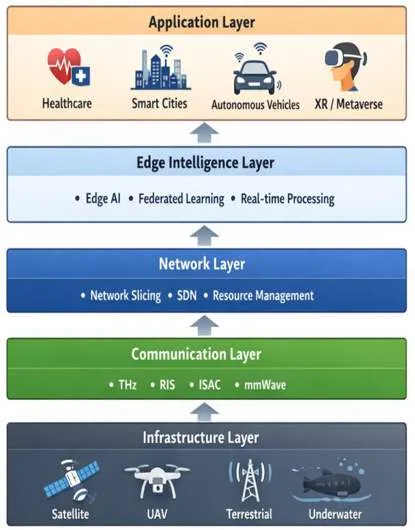
The 6G IoT architecture can be categorized into two parts viz. converged network level architecture and the high frequency RF hardware/front end architecture. The figure depicts layers of 6G IoT Architecture.
1. Converged Network Level Architecture
- 6G Intelligent Base Stations & Multi Domain Access: Act as central coordination points delivering high capacity data links, control/telemetry, and multi-orbit/multi-access integration (cellular + Wi-Fi + NTN/UAV).
- Intelligent Beamforming Subsystem: Uses large Massive MIMO (mMIMO) antenna arrays with analog, digital or hybrid beamforming, adaptive precoding, multi beam generation and AI-assisted beam management to steer narrow, high gain beams toward mobile IoT nodes.
- Reconfigurable Intelligent Surfaces (RIS): Programmable planar metasurfaces deployed on buildings or indoor walls that dynamically adjust the phase and amplitude of incoming electromagnetic waves. RIS passively or semi passively redirects signals around physical blockages to sustain line of sight links and boost energy efficiency.
- Integrated Sensing & Communication (ISAC) Layer: Shares spectrum, waveforms and transceiver hardware between communications and radar like sensing. Observations from synchronized multistatic sites can be fused to compute target range, velocity, angle, and environmental maps, exposed via standardized APIs.
- Programmable Core, Edge and Orchestration: Software defined, cloud native core networks with AI-native orchestration that balance uplink/downlink demands (especially heavy AI sensor uploads) and enforce predictive handover before link degradation occurs.
2. Advanced RF Front-End (RFFE) & Hardware Architecture
Operation at FR3, mmWave and sub-THz frequencies require specialized hardware building blocks as follows.
- Digital Baseband & Processing: Integrates digital signal processors (DSPs), dedicated AI/ML accelerators, local storage and ultra precise timing/synchronization circuits.
- Multi-Band Semiconductor Transceivers: Built using advanced processes such as CMOS, RF-SOI (including 3D wafer to wafer stacked substrates), SiGe BiCMOS (supporting > 400 GHz for sub THz operation and low noise phased arrays) and GaN for high power efficiency housing DACs/ADCs, mixers, power amplifiers (PAs), low noise amplifiers (LNAs), variable gain amplifiers (VGAs) and local oscillators.
- Low Loss Passive & Beamforming Networks: Incorporates multiplexers, couplers, power dividers, phase shifters, true time delay units, and beamforming core ICs. At mmWave/sub-THz frequencies, planar microstrip losses become prohibitive, driving adoption of Substrate Integrated Waveguide (SIW), air filled/empty SIW, gap waveguides and silicon based through silicon via (TSV) filters.
- Integrated Antenna Modules: Replaces bulky discrete feeds with Antenna in Package (AiP), Antenna on Chip (AoC), metamaterial inspired/AMC backed multiband antennas, and dedicated ISAC sensing arrays, managed by closed loop bias, thermal compensation, and self calibration circuitry.
Key Benefits of 6G IoT
- Extreme Throughput and Spectral Capacity: Expanding into FR3, mmWave, and sub-THz bands unlocks vast contiguous bandwidths capable of multi-gigabit to potential terabit per second (Tbps) links for dense IoT and immersive applications.
- Near-Zero Latency for Real Time Control: Sub-millisecond air interface responsiveness supports mission critical automation, autonomous vehicles, coordinated drone swarms and tactile/immersive digital twins.
- Dual Purpose Infrastructure via ISAC: Reusing communications hardware and spectrum for environmental sensing eliminates the cost of deploying separate sensor grids while enabling smart city surveillance, structural health monitoring and non cooperative drone detection.
- Improved Coverage and Energy Efficiency via RIS: Programmable surfaces fill dead zones caused by high frequency shadowing without requiring full active base stations, lowering infrastructure power and deployment cost.
- Truly Ubiquitous Global Connectivity: Native convergence of terrestrial 6G, Wi-Fi, aerial platforms, and LEO/MEO satellites ensures uninterrupted IoT telemetry across urban canyons, rural zones, oceans and logistics corridors.
- AI-Driven Automation and Optimization: Embedded intelligence reduces manual network tuning, streamlines beam alignment, predicts handovers and dynamically balances uplink heavy IoT sensor traffic.
Challenges and Limitations of 6G IoT
- Frequency Propagation Loss: Above 30 GHz and especially in sub-THz/THz bands signals experience extreme free space path loss, atmospheric/molecular absorption, rain fade, and severe sensitivity to blockage by walls, foliage or bodies. Links depend heavily on precise line of sight alignment and narrow beam tracking.
- Hardware Losses, Thermal Limits and Packaging Complexity: At mmWave and sub-THz wavelengths, conductor and dielectric losses rise sharply. Oscillator phase noise degrades signal integrity. AI computation and packing of antennas (AiP/AoC) into tiny IoT nodes create serious heat dissipation and yield challenges.
- Energy Consumption vs. Battery Longevity: High bandwidth ADCs/DACs, massive MIMO arrays, continuous sensing and on device AI inference consume substantial power directly conflicting with the multi year battery expectations of many IoT devices.
- Beam Management and Mobility Overhead: Tracking fast moving IoT endpoints (vehicles, UAVs, LEO satellites with high Doppler shifts) using pencil thin beams introduces heavy signaling overhead and tight timing/synchronization requirements across heterogeneous networks.
- Privacy & Security: Networks capable of sensing physical surroundings and vital signs raise new privacy and data governance requirements.
- Many sub-THz components, hybrid RIS architectures and large scale ISAC algorithms still require extensive real world validation before commercial rollout.
Summary
6G IoT delivers transformative advantages including multi gigabit to terabit class data rates, sub-millisecond latency, dual use network sensing via ISAC, obstacle bypassing coverage through RIS and global terrestrial to satellite continuity.
Continue Learning 6G Wireless Technology : Building Blocks of 6G
- 6G Wireless Network Basics Tutorial
- 6G Network Architecture & its interfaces
- Reconfigurable Intelligent Surfaces (RIS) in 6G
- AI Native in 6G Wireless Networks
- CoMP & RIS : Security in 6G
- RF Fingerprinting in 6G
- Physical Layer Security in 6G
- What is Autoencoder in 6G
- What is OAM Multiplexing in 6G
- What is OTFS Waveform in 6G
- MAC Layer Security Concepts in 6G