
Telecom Antenna Evolution: 1G 2G 3G 4G 5G 6G Networks
By RF Wireless Expert Team
Advertisement
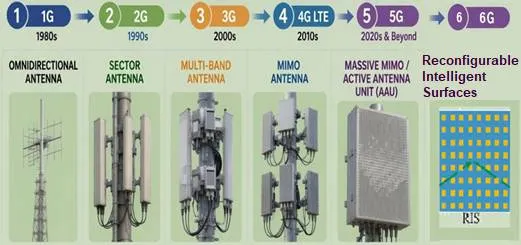
Telecom antenna evolution from 1G to 6G reflects the rapid development of mobile communication technologies, from simple voice oriented networks to high capacity, low latency and intelligent wireless systems. Each generation from 1G, 2G, 3G, 4G, 5G and emerging 6G; has introduced new antenna requirements involving frequency bands, bandwidth, gain, beamforming, MIMO, massive MIMO and spatial coverage. This article explains how cellular antennas have evolved across generations and compares their key characteristics, technologies and applications.
1G: The Omnidirectional Era (1980s)
- The earliest cellular networks relied on simple Omnidirectional Antennas.
- These antennas functioned essentially like a traditional radio tower or a bare lightbulb, radiating a signal uniformly in a 360-degree circle around the mast.
- Designed strictly for analog voice calls, these setups had very low capacity. Because they broadcast everywhere indiscriminately, they were prone to high levels of interference from neighboring towers, limiting how closely cell sites could be placed together.
2G: The Move to Sectors (1990s)
- The introduction of digital voice required better network management, leading to the Sector Antenna.
- Instead of one antenna blasting a 360-degree signal, the tower was divided into “sectors” (typically three antennas, each covering a 120-degree slice of the pie).
- This was a significant leap. By directing the signal into specific areas rather than everywhere at once, operators reduced interference (improving frequency reuse) and gained better control over coverage and capacity.
3G: Consolidating Frequencies (2000s)
- As mobile data joined voice services, networks required more spectrum. To manage this without overcrowding cell towers, the Multi-band Antenna was developed.
- These antennas were engineered to support multiple frequency bands (e.g., 900 MHz, 1800 MHz, 2100 MHz) within a single physical enclosure.
- This improved the physical efficiency of cell towers, requiring fewer individual antennas to support legacy 2G networks alongside new 3G data networks.
4G LTE: Multiplying Data Streams (2010s)
- The explosion of smartphones and video streaming demanded a massive increase in data throughput, leading to the adoption of MIMO (Multiple Input, Multiple Output) Antennas.
- Rather than a single stream of data, MIMO uses multiple transmitting and receiving antennas (e.g., 2x2, 4x4, or 8x8 configurations) to send multiple data streams simultaneously over the same radio channel.
- This acts like adding lanes to a highway. It significantly increases data speeds, improves signal quality, and enhances reliability without requiring more frequency spectrum.
5G: Smart, Active, and Massive (2020s)
- To handle ultra-high capacity and low latency, 5G introduced Massive MIMO and Active Antenna Units (AAUs).
- Massive MIMO scales up 4G technology dramatically, using arrays of dozens or hundreds of antenna elements (e.g., 64T64R or 128T128R) within a single panel. Furthermore, the radio equipment itself is integrated directly into the antenna unit (AAU), reducing signal loss from cabling.
- The key innovation here is Beamforming and Beam Tracking. Instead of broadcasting broadly, a 5G antenna acts like a laser, electronically shaping and steering concentrated beams of data directly to individual user devices, moving with them as they walk or drive.
6G: The Future of Sensing and Terahertz (2030s and Beyond)
- 6G is expected to utilize much higher frequencies in the Sub-Terahertz and Terahertz (THz) bands. Because higher frequencies have shorter wavelengths, the physical antenna elements will become microscopic, allowing for incredibly dense “Massive-Massive MIMO” arrays on very small devices.
- 6G antennas will likely move beyond simple communication and become integrated sensors. Using “Joint Communication and Sensing (JCAS),” the network will act like a radar, mapping the physical environment to optimize connections.
- We will also likely see the rise of Reconfigurable Intelligent Surfaces (RIS). Instead of just cell towers, the environment itself (walls, windows, billboards) will be covered in smart, programmable materials that act as passive antennas, reflecting and steering 6G signals around obstacles to guarantee continuous ultra-fast connectivity.
Summary
Cellular antennas have evolved from basic 1G voice antennas to advanced 5G massive MIMO and future 6G intelligent antenna systems.
Explore Different Types of Antennas
-
Check-out: Guide to List of Antenna Types >>