Smart Hydroponics & the Future of Indoor Farming
Advertisement
Introduction : Hydroponics is the practice of growing plants without soil by using water based mineral nutrient solutions. Historians believe the Hanging Gardens of Babylon relied on a rudimentary form of it. However, for centuries, successfully growing food indoors required a deep understanding of botany, strict manual monitoring and a lot of trial and error.
Today, the Internet of Things (IoT) is eliminating the guesswork. By merging hydroponics with wireless sensor networks, Edge computing and smartphone apps, tech companies are creating Smart Growers. These connected miniature farms act as fully automated, closed loop ecosystems, allowing anyone to grow perfect crops right in their kitchen, while also laying the groundwork for massive commercial vertical farms. This article describes how IoT sensors and Bluetooth Low Energy (BLE) are driving the future of indoor agriculture.
How IoT Sensors Optimize the Perfect Yield
To thrive, a plant needs precise amounts of water, specific nutrients, an ideal ambient climate and the correct spectrum of light. In a smart hydroponic system such as aspara Smart Grower, a network of embedded IoT sensors acts as the “nervous system” of the planter, constantly monitoring these variables.
1. Precision Water and Nutrient Management
Traditional potted plants often suffer from human error such as overwatering or negligence. Smart hydroponic systems utilize water level and flow sensors submerged in the nutrient reservoir.
Instead of relying on a human schedule, the system’s microcontroller dynamically calculates exactly how much water the roots are consuming. It can then automatically trigger internal pumps to irrigate the plants from a removable tank. Furthermore, conductivity sensors measure the concentration of nutrients in the water, ensuring the plant is being fed the exact mineral ratio it needs for its current growth stage.
2. Dynamic Light Spectra and Intensity
Plants do not just need light; they need specific types of light. Blue light promotes leafy growth, while red light triggers flowering and fruiting. Smart growers use ambient light sensors to measure how much natural sunlight the room is providing.
If a cloud passes over, or if it is night time, the IoT system instantly compensates by activating integrated LED grow lights. Even more impressively, the system alters variable light spectra and intensity on the fly, tailoring the exact wavelength of light to stimulate optimal plant development depending on whether the plant is germinating, growing or harvesting.
3. Microclimate Control
Temperature and humidity sensors constantly monitor the air immediately surrounding the leaves. If the environment falls out of the ideal range for a specific crop (e.g. tomatoes vs. basil), the smart grower can adjust its internal fans to manage airflow and cool the canopy, replicating a gentle outdoor breeze.
The Role of Bluetooth LE in Smart Farming
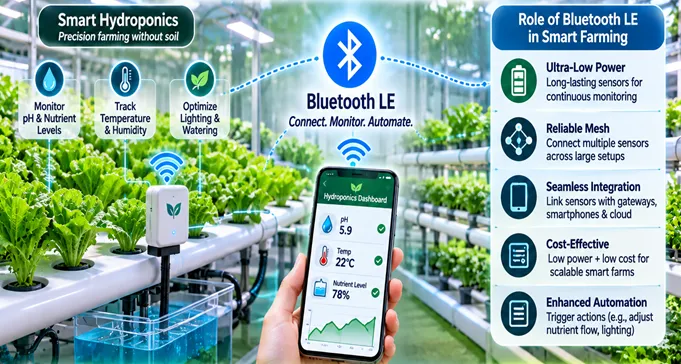
All of these sensors require a central brain to process their data and communicate with the human user. This is where Bluetooth Low Energy (BLE) comes in.
Hardware engineers utilize highly efficient, multiprotocol System on Chips (SoCs) like Nordic Semiconductor’s nRF52 series to control the smart grower. BLE is the ideal wireless protocol for this application for several reasons as follows.
-
Ultra-Low Power Consumption: By utilizing BLE, the microcontrollers sip micro-amps of power. Even though a smart grower is usually plugged into the wall, keeping the computing power draw exceptionally low ensures the device runs efficiently and generates minimal excess heat (which could otherwise damage the plants).
-
Direct Smartphone Integration: Because BLE is natively built into every modern iOS and Android device, users can connect directly to their indoor garden without needing to configure complex Wi-Fi router settings or buy third party smart home hubs.
-
Real-Time Data Processing: The BLE SoC doesn’t just transmit data; it processes it. It takes the raw data from the humidity, light and water sensors, runs it through local algorithms and adjusts the planter’s conditions dynamically.
App-Driven Agriculture
The true “smart” aspect of modern hydroponics is the companion software.
Through the BLE connection, the smart grower syncs with a smartphone app. This app acts as a digital agronomist. Users can select exactly what species they are planting and the app downloads a specific “growth program” to the planter’s hardware.
The user no longer needs to remember when to tend to the garden. The app interprets the IoT sensor data and sends proactive push notifications such as follows.
- “Your tomatoes need more water in the tank”
- “Nutrient levels are low, please add Plant Food B”
It also provides the user with historical charts showing growth progress, environmental stats, and tips for optimizing plant health.
Conclusion
While consumer smart growers are transforming home kitchens, the underlying IoT technology is highly scalable. It is currently being deployed in giant commercial indoor vertical farms. By utilizing IoT to optimize every single drop of water and photon of light, smart hydroponics promises a future where we can grow significantly more food, in vastly smaller spaces, using a fraction of the resources of traditional agriculture.
Continue Learning IoT Basics, Architecture & Tutorials
- IoT Tutorial: Basics, Architecture & Protocol Stack
- Understanding IoT Architecture: Levels 1 to 5
- IoT Stack vs Web Stack
- Advantages, Disadvantages, and Applications of IoT
- Ambient IoT : Advantages & Disadvantages of A-IoT
- Physical Layer Security for IoT Networks in 6G
- IoT Wireless Technologies and Standards
Hardware: IoT Sensors, Actuators & SoCs
- Understanding IoT Sensors
- Understanding IoT System-on-Chip (SoC) - RS9113
- Actuator Types: IoT Guide
- Soft Actuators in IoT
- IoT Antenna Types
Real-World IoT Applications & Systems
- Top 10 Applications of IoT
- IoT Based Smart City Architecture
- IoT Based Healthcare System Architecture
- IoT Weather Monitoring System Architecture
- IoT Smart Retail System Architecture
- IoT Air Pollution Monitoring System Architecture
- IoT Based Intelligent Traffic System
- IoT Environmental Monitoring System
- IoT Elderly Fall Detection System
- IoT Perishable Food Delivery System
- IoT Radiation Monitoring System
- IoT Smart Driver Assistance System
- IoT Water Quality Monitoring System
- IoT in Manufacturing
- Smart Lavatory IoT: Aircraft Cleanliness Monitoring
- Satellite IoT Network Architecture
- Cellular IoT Overview