
NFC Wireless Charging (WLC): Pros, Cons & Uses
Advertisement
Introduction : We have seen Qi (Wireless Power Consortium) as dominant standard powering our phones and tablets. As our gadgets shrink from smart rings, hearing aids to digital styluses, bulky copper coils used in Qi charging may no longer be useful. Qi uses frequency from 85 to 205 KHz, antenna size of about greater than 10 cm^2 and max. power of about 15+ Watts.
While NFC (Near Field Communication) is famous for contactless payments and pairing Bluetooth speakers, the NFC Forum officially introduced a specification allowing the technology to transmit power alongside data. It’s not here to replace Qi, but to fuel the “Internet of Tiny Things.” Let us understand how it works before we learn about its pros and cons.
How NFC wireless charging works?
Unlike Qi, which operates at low frequencies (i.e. 100-200 KHz) using inductive coupling with large ferrite backed coils, NFC operates at 13.56 MHz.
NFC Wireless Charging (WLC) uses same antenna for communication as well as power transfer. There are two components in the system viz. nfc poller and listener. By manipulating magnetic field, NFC poller (e.g. smartphone or payment terminal) can send up to 1 Watt of power to a listener (e.g. small IoT device) while exchanging data at the same time. Following are some of major features of NFC Wireless Charging (WLC).
- Frequency : 13.56 MHz
- Max. Power : ~ 1 Watt (Standard)
- Antenna size : Tiny (less than 1 cm^2), printable, flexible
- Data Speed : 106 yo 848 kbps (bi-directional)
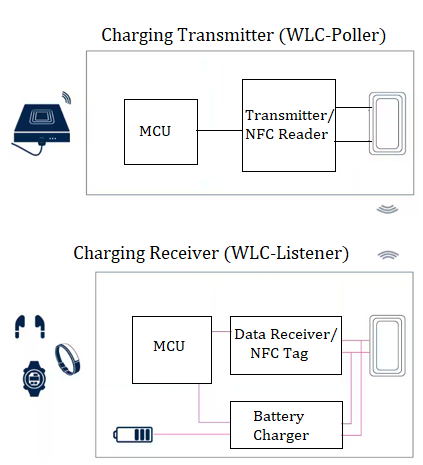
The figure depicts NFC based wireless charging transmitter (WLC-Poller) and charging receiver (WLC_Listener). In the figure, MCU refers to microcontroller unit having suitable interfacing ports and interfaces such as I2C, UART as desired.
Pros of NFC Wireless Charging
Following are some of the benefits or advantages of NFC wireless Charging.
- Unmatched Miniaturization : Qi coils are effectively too large for devices like smart glasses or fitness rings. Instead, NFC antennas can be printed onto flexible PCB and are smaller than 1 cm^2. It can also be bent to fit inside curved casings.
- Reduced BOM (Bill of Material) : If a device already needs NFC for pairing or data transfer, using that same chip for charging eliminates the need for a separate wireless power receiver and a separate coil. This reduces the component count, saves internal space and lowers manufacturing costs.
- Since almost every modern smartphone already has an NFC controller for Google Pay or Apple Pay, a firmware update or minor driver tweak can theoretically turn any NFC phone into a charger for small accessories.
- Qi has a unidirectional communication stream mostly used to regulate power. On the other hand, as NFC is a communication protocol first; this means your device can perform a secure handshake, update firmware or sync health data while it is charging, without needing a separate Bluetooth connection.
Cons of NFC Wireless Charging
Following are some of the drawbacks or disadvantages of NFC wireless Charging.
- Power Limit : NFC standard specification caps out at 1 Watt (practically often 250mW to 500mW). Qi standard starts at 5W and goes up to 15W (or 60W+ in proprietary modes). You would never charge a smartphone with NFC; it would take days.
- The transmission distance is very short (typically < 2cm).
- Thermal Management : Because NFC antennas in this context are often PCB traces rather than thick copper wire, resistance can be higher. Pushing the power limits on a PCB antenna can generate heat. This is a limiting factor in why the power delivery is kept so low.
Summary
- Qi (and the newer Qi2 with magnetic alignment) will remain the standard for smartphones and vehicles. It handles the heavy lifting where speed and power are non negotiable.
- NFC Wireless Charging wins in the margins. It is the champion for the “wearable” and “hearable” markets. As we move toward a future where our glasses, rings, earbuds and even buttons are “smart,” NFC offers the only viable way to cut the cord without making the device bulky.
Advertisement


