
What is 3D Printer : Features & Top Manufacturer Companies
Advertisement
A 3D printer is an advanced manufacturing device that creates three dimensional objects by building material layer by layer from a digital design file. Key features of 3D printers include high precision, rapid prototyping, customization, reduced material waste and the ability to produce complex geometries. Leading 3D printer manufacturers include Stratasys, 3D Systems, Altem Technologies and Afinia, serving industries such as healthcare, aerospace, automotive and consumer products.
Traditional printers are not capable of producing 3-Dimensional (3D) prints. This limitation often requires more time and effort in designing and developing prototypes. Fortunately, 3D printers are now available, capable of printing 3D documents and pictures.
These printers accept .stl files and convert them into gcode files. The gcode files are then used to print the layers one by one, building the 3D object. 3D printers are invaluable for quickly checking mechanical designs and ensuring proper fitment.
In contrast to traditional printing processes where you need to wait for prototype films, 3D printing allows for immediate physical evaluation of designs.
There are two primary types of 3D printers:
- DIY (Do It Yourself): These kits require assembly using a manual.
- Assembled: These printers arrive ready-to-use, allowing you to start printing immediately.
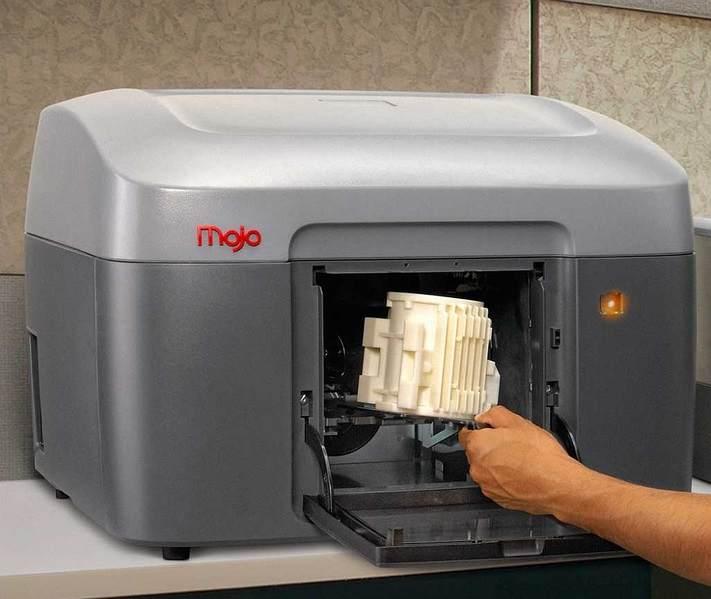
The following figure depicts the mojo 3D printer manufactured by Stratasys ltd.
3D Printer Selection Guide
Before purchasing a 3D printer, consider the following specifications:
- Maximum Print Size: The largest dimensions the printer can produce.
- Horizontal and Vertical Resolutions: The level of detail the printer can achieve.
- Print Speed: How quickly the printer can complete a print job.
- Number of Print Heads (Extruders): The number of different materials or colors the printer can use simultaneously.
- SD Card and Display Support: Allows for standalone printing without a computer connection.
An SD card allows the printer to store print files and operate continuously without needing a constant computer connection.
Carbon fiber materials are often used in 3D printers, typically in the form of composites, for their strength and lightweight properties.
Assembled Desktop 3D Printer Manufacturers
| Manufacturer or Vendor | 3D Printer Model |
|---|---|
| Afinia | H479 |
| 3D Protomaker | Sprint |
| 3D Systems | Zprinter 850 |
| Stratasys | Object 1000 |
| Makerbot | Replicator 2 |
| Airwolf 3D | AW3D HD |
| Altem Technologies | uPrint SE |
| CAD Centre | Projet 7000HD |
| Amptronics Systems | Dual Extruder 3D printer |
| Cubify | CubeX |
| KCBots | KUBE |
| J Group Robotics | Dimension LE |
Software Tools for 3D Printing
Several software tools facilitate the 3D printing process.
- Slicer: Helps represent 3D printing geometry, preparing the model for printing.
- TinkerCAD: Can convert normal image files into 3D image files.
DIY 3D Printer Manufacturers
| Manufacturers | 3D Printer Model |
|---|---|
| RS Components | RepRap Pro Omerod |
| Lulzbot | TAZ 4 |
| 3D Printronics | Felix 2.0 |
| Amptronics | Prusa Mendel LM8UU |
| Chipmax | MBot Cube |
Conclusion
3D printing technology is transforming modern manufacturing by enabling faster product development, cost-effective production and highly customized designs. With features such as precision, flexibility, and reduced material waste, 3D printers are becoming essential across industries. Leading manufacturers continue to innovate with advanced solutions, making 3D printing more accessible and efficient. As adoption grows, this technology is expected to play a significant role in shaping the future of manufacturing, prototyping, healthcare, aerospace and many other sectors.
Advertisement


