
Plasma Arc Welding and Cutting: Advantages and Disadvantages
Advertisement
Plasma arc welding and cutting use a high-temperature plasma jet to join or cut electrically conductive metals with exceptional precision. The process provides deep penetration, fast cutting speeds, and excellent weld quality, making it suitable for industrial manufacturing and metal fabrication.
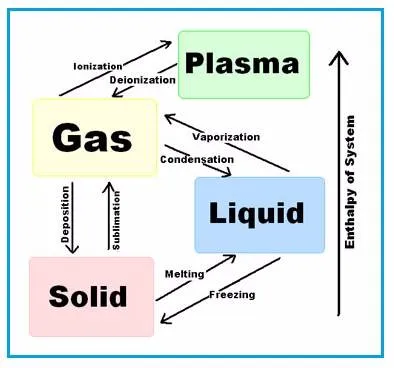
As the figure illustrates, the four fundamental states of matter are solid, liquid, gas, and plasma. The graphic depicts the transitions between these states.
Advantages of Plasma Arc Cutting
Here are the benefits of using Plasma Arc Cutting:
- Versatility: Can cut any type of metal.
- Speed: Cutting speeds are significantly faster (5 to 10 times) compared to Oxy-fuel cutting.
- Precision: Leaves a narrower kerf (cut width).
- Thickness Capacity: Capable of cutting materials up to 150mm thick.
- Automation: Easily adaptable to automated cutting systems.
Disadvantages of Plasma Arc Cutting
Here are the drawbacks of using Plasma Arc Cutting:
- Heat Affected Zone: Creates a larger heat-affected zone (HAZ) which can impact material properties.
- Surface Finish: Produces relatively rough surfaces.
- Corner Definition: Difficult to achieve sharp corners.
- Environmental Concerns: Generates smoke and noise.
- Burr Formation: Often results in burr formation along the cut edge.
- Initial Investment: High initial equipment cost.
Advantages of Plasma Arc Welding
Here are the benefits of using Plasma Arc Welding:
- Arc Control: Torch design allows for superior arc control.
- Visibility: Provides better visibility and control of the weld pool.
- Travel Speed: The high heat concentration and plasma jet enable faster welding speeds.
- Penetration: The high temperature and concentrated heat create a keyhole effect, providing complete penetration with single-pass welding for many joints.
- Reduced HAZ: Smaller heat affected zone compared to GTAW (Gas Tungsten Arc Welding).
Disadvantages of Plasma Arc Welding
Here are the drawbacks of using Plasma Arc Welding:
- Weld Width: Produces wider welds and larger HAZ compared to Laser Beam Welding (LBW) and Electron Beam Welding (EBW).
- Equipment Cost: Plasma welding equipment is expensive, resulting in higher startup costs.
- Skill Requirement: Requires specialized training and expertise.
- Radiation Emission: Emits ultraviolet and infrared radiation.
- Noise Levels: Generates high noise levels, around 100dB.
- Torch Size: The bulky torch design can make manual welding challenging and requires specialized training.
Summary
Plasma arc welding and cutting use ionized gas to produce precise, high-temperature metal joining and cutting. They deliver high accuracy, fast processing, and superior weld quality.