
What is RF Transformer : Selection & Top Manufacturers
Advertisement
An RF transformer is a passive component used for impedance matching, signal coupling, isolation, and balanced to unbalanced signal conversion in RF circuits. RF transformers play a critical role in communication systems, amplifiers, mixers, antennas, and microwave networks requiring efficient signal transfer.
The most common core material used in RF transformers is a toroid. A toroid is a doughnut-shaped core made of a special type of powdered iron material. To create an RF transformer, copper wire is wound around the toroid to form both primary and secondary windings.
Figure 1 illustrates various transformer symbols based on the core type used.
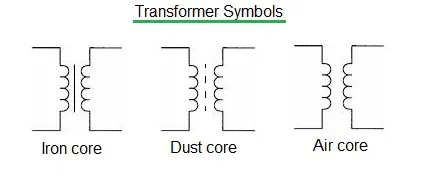
Figure 1: Transformer Symbols
Selection Guide of RF Transformer
The following are key parameters to consider when selecting an RF transformer:
- Frequency Range: The range of frequencies over which the transformer operates efficiently.
- Impedance Ratio: The ratio between the input and output impedance (e.g., 1:1, 4:1, 16:1).
- Insertion Loss: The signal attenuation introduced by the transformer. It should be as low as possible to minimize signal degradation.
- RF Power Level Capability: The maximum power level the transformer can handle without damage or performance degradation.
- Phase Balance & Linearity: Important for maintaining signal integrity, especially in communication systems.
- Size: The physical dimensions of the transformer, crucial for space-constrained applications.
- Packaging: Whether the transformer is designed for Surface Mount Device (SMD) or through-hole mounting.
- Core: The type of core material used (e.g., ferrite, air, or transmission line type).
- Environmental Stability: The transformer’s ability to operate reliably under varying temperature, humidity, and electromagnetic conditions.
Benefits of RF Transformer
RF transformers offer several advantages in RF circuit design:
- Efficient Power Transfer: Ensures efficient power transfer between RF circuits, reducing signal reflection and losses.
- Electrical Isolation: Provides electrical isolation between circuits, preventing unwanted interference and protecting sensitive components.
- Wide Frequency Range: Supports applications across RF, microwave, and millimeter wave frequencies, offering versatile use.
- Miniaturization: Available in miniaturized designs, making them suitable for space-constrained applications like mobile devices and satellite systems.
- Signal Integrity: Minimizes phase and amplitude imbalances, ensuring high-quality signal transmission in RF communication systems.
Manufacturers of RF Transformer
The following table lists popular manufacturers or vendors of RF transformers:
| RF Transformer Manufacturers | Description | Website |
|---|---|---|
| Coilcraft, USA | www.coilcraft.com/ | |
| Johanson Technology, USA | https://www.johansontechnology.com/ | |
| AVX Corporation, USA | www.avx.com/ | |
| MiniRF, USA | www.minirf.com/ | |
| MACOM, USA | https://www.macom.com/ | |
| Mini-Circuits | https://www.minicircuits.com/ | |
| RFMW, USA | https://www.rfmw.com/ | |
| Murata, Japan | www.murata.com/ | |
| Pulse electronics, USA | https://www.pulseelectronics.com/ | |
| Synergy Microwave Corporation | synergymwave.com |
Summary
An RF transformer provides impedance matching and signal coupling for RF and microwave circuits. Manufacturers offer RF transformers for communication systems, radar equipment, amplifiers, and wireless infrastructure.