
UWB O-QPSK PSD Mask Test: Significance & Limits
Advertisement
Introduction : With the introduction of Narrowband (NB) Assistance in IEEE 802.15.4ab, UWB devices now operate in the crowded 5 GHz and 6 GHz bands alongside Wi-Fi. To prevent interference, the standard enforces a rigorous O-QPSK Transmit Power Spectral Density (PSD) Mask Test.
While traditional UWB uses ultra-wide pulses (500 MHz bandwidth), the 802.15.4ab standard introduces a companion “Narrowband” radio (operating in 5800 MHz or 6200 MHz bands) to handle control data and synchronization. This test ensures that this specific Narrowband radio “stays in its lane” and does not cause interference.
What is the O-QPSK PSD Mask Test?
This test measures the Power Spectral Density (PSD) of the Narrowband O-QPSK transmitter to verify that its energy is contained within a specific frequency limit and drops off sharply outside that limit.
The Test Setup:
- Resolution Bandwidth (RBW): 100 kHz.
- Video Bandwidth (VBW): 1 kHz (for CF/Symbol rate alignment tests).
- Frequency Bands: 5800 MHz (UNII-3) and 6200 MHz (UNII-5).
The Mask Limits:
The standard defines a “Relative Limit” mask:
- Reference Level (0 dB): The highest average spectral power measured within +/- 1 MHz of the carrier frequency (fc).
- The Drop-off Point: At frequency offsets greater than 3.5 MHz (|f-fc| > 3.5 MHz), the signal power must drop by at least 20 dB.
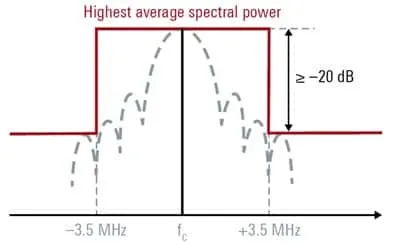 Image Courtesy : Rohde & Schwarz
Significance in UWB
Following are some of the benefits which are critical for the PSD mask test.
- Protecting the channel grid (i.e. interference mitigation)
- Regulatory compliance (5 GHz/ 6 GHz Bands)
- Ensuring efficient offloading
- Signal Quality Verification
Summary: Strict adherence to this mask protects the integrity of the control data that manages the UWB link, ensuring that the power saving benefits of Narrowband Assistance are not lost to interference and retransmissions.
Explore More UWB Test & Measurement Resources
- UWB PHY Layer Conformance Testing
- UWB MAC Layer Conformance Testing
- UWB Measurements & Conformance Testing
Continue Learning UWB Technology
- UWB Basics Tutorial
- UWB Physical & MAC Layers
- UWB Frame Structure
- Understanding UWB Networks
- UWB Radar Tutorial
- UWB : Key Advantages & Disadvantages
- UWB Anchor Vs Tag : Key differences
- UWB Antenna Types & their benefits
Continue Learning Modulation Types
- AM Vs. FM Vs. PM : Difference between Analog Modulation Techniques
- ASK Vs. FSK Vs. PSK : Difference between Digital Modulation Techniques
- PAM Vs. PWM Vs. PPM : Difference between Pulse Modulation Techniques
- BPSK Vs. QPSK : Key Differences
- 16-QAM Vs. 64-QAM Vs. 256-QAM : Key Differences
- 512-QAM Vs. 1024-QAM Vs. 2048-QAM Vs. 4096-QAM
- 4096QAM Modulation Used in Wi-Fi 7
- MSK Vs. GMSK : Modulation Technique used in GSM
- LORa Modulation Used in LoRaWAN
- 10% ASK & 100% ASK Modulation used in NFC
- OOK Vs. VPPM Vs. CSK : Visible Light Communication (VLC) Modulation Techniques
- QPSK Vs. OQPSK Vs. PI/4 QPSK
- PAM4 Modulation Used in Gigabit Ethernet
- CCK Vs. DSSS Vs. OFDM Used in WLAN (Wi-Fi) Standards