
What is VLC Communication: Advantages and Disadvantages
By RF Wireless Expert Team
Advertisement
Visible Light Communication (VLC) is a wireless communication technology that uses visible LED light to transmit digital data at high speeds. Its advantages include high bandwidth and immunity to radio interference, whereas its disadvantages include line of sight requirements and limited communication through physical obstacles.
Key Features of VLC and its Li-Fi use case
- VLC utilizes light as the medium for communication between a source and a receiver.
- It has various applications, including underwater communication, in-flight communication inside airplanes, vehicle-to-vehicle communication, and indoor broadcast systems for internet access (LiFi).
- VLC uses wavelengths between 380 nm and 750 nm (430 THz to 790 THz) for data transmission.
- Data is modulated onto the light, usually emitted by LED sources.
- The receiver employs a photodiode to recover the data.
- A Line-of-Sight (LOS) connection between the source and receiver is essential for VLC to function correctly.
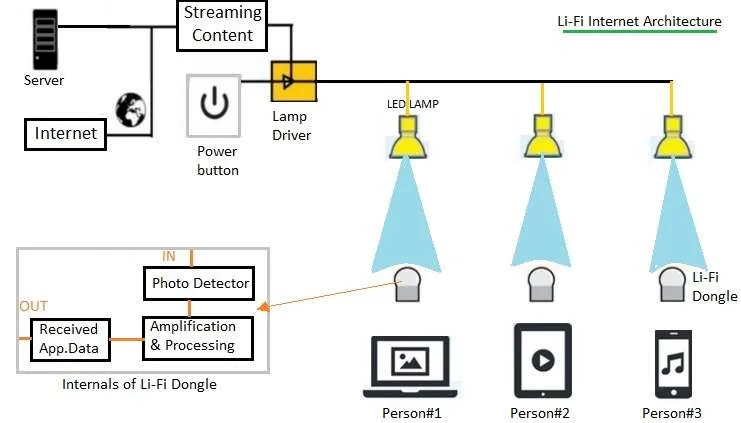
Figure 1: Li-Fi internet architecture example.
Benefits (Advantages) of VLC Communication
Here are some advantages of VLC communication:
- Higher Bandwidth: Supports larger bandwidths, overcoming the limitations of RF communication.
- Secured Communication: VLC communication within a room cannot be intercepted from another room, unlike RF communication.
- Power Efficient: VLC sources are used for both illumination and communication, resulting in low power consumption.
- EM Radiation Immunity: Unaffected by electromagnetic radiation from RF systems.
- Safe for Humans: Poses no known health risks to human beings.
- Simple to install.
Drawbacks (Disadvantages) of VLC Communication
Here are some disadvantages of VLC communication:
- Interference: Susceptible to interference from ambient light sources.
- Short Range: Limited coverage range.
- Integration Challenges: Integrating VLC with existing Wi-Fi systems can be challenging.
- Environmental Factors: Atmospheric absorption, shadowing, and beam dispersion can negatively impact performance.
- Line-of-Sight Requirement: Requires a direct line of sight between the source and receiver, making non-LOS communication difficult.
Summary
Visible Light Communication offers fast, secure, and spectrum-efficient wireless connectivity by utilizing existing LED lighting infrastructure for data transmission.