
What is Vertical Antenna : Advantages and Disadvantages
By RF Wireless Expert Team
Advertisement
A vertical antenna is a monopole or dipole antenna mounted perpendicular to the ground for omnidirectional radio signal transmission and reception. Its advantages include simple installation and wide coverage, whereas its disadvantages include lower gain and sensitivity to ground conditions in certain operating environments. This page specifically focusing on the λ/4 radiating element type.
Introduction: The radial wires of a ground mounted vertical antenna should be placed on the surface or buried a few inches below the ground.
Examples:
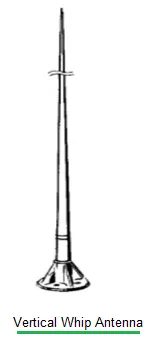
- Vertical whip antenna
- λ/4 monopole antenna
- It is also known as the Marconi antenna.
- Vertical antennas are commonly used for frequencies under 2 MHz.
Benefits or Advantages of Vertical Antennas
- Smaller Size and Smaller Footprint: Vertical antennas generally require less space compared to other antenna types.
- Higher Efficiency with 6 dB Gain: They can offer good efficiency with a decent gain, making them effective for transmitting and receiving signals.
- Little Induction Field with Very Little Coupling: This characteristic helps reduce interference with nearby devices.
- Broad Bandwidth: Vertical antennas often offer a wider bandwidth, allowing them to operate over a larger frequency range.
- Reduced Land Use: Due to their compact design, they require less land for installation.
- Reduced Hazards for Aircraft: Their vertical orientation minimizes potential hazards for aircraft.
- Inexpensive and Fairly Easy to Build: Vertical antennas can be relatively inexpensive and straightforward to construct.
- Can be Quite Sensitive: They can be highly sensitive to incoming signals, making them good receivers.
- Resistant to Feeder Conducted Electrical Noise: Vertical antennas are less susceptible to electrical noise conducted through the feeder cable.
Drawbacks or Disadvantages of Vertical Antennas
- Better Sensitivity Requires More Vertical Height: To achieve better sensitivity and performance, a greater vertical height may be necessary.
- Better Quality Ground Delivers Better Signal: The quality of the ground connection significantly impacts the antenna’s performance. A good ground is crucial for optimal signal transmission and reception.
Summary
Vertical antennas provide reliable omnidirectional coverage for broadcasting, mobile communications, and amateur radio while maintaining a compact and practical design.
Continue Learning About Antenna Technology
- Antenna Basics Tutorial
- Antenna Related Terms
- Antenna mechanical Vs. electrical tilt
- Difference between antenna gain directivity efficiency
- Antenna gain & effective area
- Bandwidth Vs. beamwidth antenna difference
- Antenna Factor
- Near field Vs. Far field antenna radiation pattern