
What is Verbal Communication: 5 Advantages and Disadvantages
Advertisement
Verbal communication is the process of exchanging information, ideas, thoughts, and emotions through spoken words. Effective verbal communication improves understanding, strengthens relationships, enables quick feedback, and supports collaboration, decision making, and problem solving activities. Advantages of verbal communication include immediate feedback and clear interaction, while its disadvantages include misunderstandings caused by language barriers, tone variations or ineffective listening. Non-verbal communication uses facial expressions, body language, gestures, eye contact, posture, and tone of voice to enhance or complement communication.
There are different types of communication people use as follows:
- Written communication - formal, informal
- Verbal communication - formal, informal
- Non-verbal communication
- Paralingual communication: The tone and pitch of your voice when you are talking to people.
What is Verbal Communication?
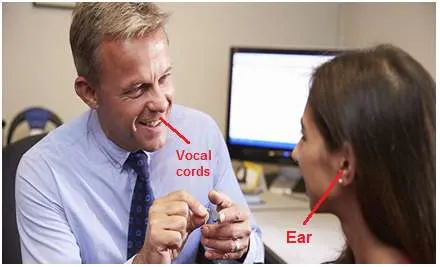
Verbal communication, also known as oral communication, uses words as the medium for communication. It requires the use of speech organs to produce sounds that are perceived by the ears of the receiver. In other words, it is spoken language, human speech, or sounds.
Different languages, such as English, Hindi, Tamil, Telugu, and Slavic, are used for communication. For effective understanding, both parties must be familiar with the language.
The image below shows a man and woman communicating using speech organs like the vocal cords and ears.
Formal verbal communication is used in professional or official settings, where the exchange of information is structured, follows established guidelines, and is very useful. Informal verbal communication is used in casual, social, and personal contexts.
Examples of verbal communication:
- Formal presentations, business meetings, and job interviews are types of formal verbal communication.
- Conversations with friends/family members and informal gatherings are types of informal verbal communication.
Types of Verbal Communication
Verbal communication refers to the exchange of information through spoken words. Here are some of its types:
- Face to face conversation: Direct conversation between two or more individuals, offering the ability to clarify misunderstandings in real-time.
- Telephone communication: Communication using telephones or mobile phones (nowadays). It allows individuals to speak and listen to each other without being physically present.
- Video conferencing: Allows people in different parts of the world to see and hear each other in real-time. It facilitates remote meetings, interviews, and collaborations. Popular applications include Google Meet, GoTo Meeting, WhatsApp Messenger, and Skype.
- Public speaking: Delivering a message or presentation to a larger audience.
- Formal presentations: Using visual aids like slides or charts to enhance the spoken message, improving audience understanding. It is a structured form of verbal communication where the speaker delivers information to an audience.
- Job interviews: Assessing candidates based on their ability to answer questions.
- Group discussions: Multiple individuals engaged in conversation to exchange ideas, share perspectives, and reach decisions collectively.
- Other types: Debates, coaching and mentoring, interpersonal communication, etc.
Verbal Communication Improvement Skills
Good verbal communication skills are essential for effective interpersonal interactions and professional success. Here are some tips to enhance your verbal communication abilities:
- Practice active listening with full attention. Listening to the radio with your favorite station is advisable.
- Expand your vocabulary by learning new words daily and using them in conversations. Read books, articles, and written materials like newspapers.
- Organize your thoughts before speaking and use simple, concise language.
- Maintain an open and confident body posture with appropriate eye contact and facial expressions while speaking.
- Actively seek feedback from others about your communication skills.
- Consider enrolling in public speaking courses or workshops.
- Participate in conversations and discussions to practice your verbal communication skills.
- Record yourself speaking and listen back to identify areas for improvement. Use recording technologies to perform this task.
Top 5 Advantages of Verbal Communication
- It saves time in communication.
- It allows for quick feedback.
- It provides a complete understanding of the delivered communication, with the chance to clarify any doubts in interpretation.
- It is a more reliable method of communication.
- It is flexible and effective for all.
- It is a powerful means of persuasion and control.
- It is a cheaper way of communication, saving money.
Top 5 Disadvantages of Verbal Communication
- Visible emotions can lead to trouble in certain cases.
- It has no legal validity, which can lead to problems in certain situations.
- It does not provide a permanent record unless recorded.
- It has issues when communicating with distant people.
- It can be difficult for some people to understand due to varying speech tones.
- This form of communication is not suitable for lengthy messages.
- There is a chance of leaking secret information with modern devices like polygraphs or lie detectors, especially when someone is under the influence of alcohol.
What is Non-Verbal Communication?
Individuals without proper speech organs cannot produce sound, and those without ears cannot participate in verbal communication. For these individuals, non-verbal communication is employed to help them communicate and pass information.
Nonverbal communication refers to the exchange of information without the use of spoken words. It involves facial expressions, gestures, body language, posture, eye contact, sign languages, and other nonverbal cues.
Examples of non-verbal communication:
- Gestures
- Physical appearance
- Facial expressions
- Hand movements
- Leg movements
- Sitting posture
- Touch
- Dance
Top 5 Advantages of Non-Verbal Communication
- It helps clarify and reinforce spoken messages, making it easier for the receiver to understand the intended meaning. For example, a “smile face” conveys friendliness and warmth, while a “frown face” conveys disappointment.
- It is effective in expressing emotions and attitudes.
- It plays a crucial role in building rapport and trust between people. For example, eye contact and nodding indicate attentiveness and interest during a conversation.
- It helps listeners provide feedback to the speaker during a conversation.
- It transcends language barriers, facilitating effective communication in multicultural and diverse settings, enhancing cross-cultural communication.
Top 5 Disadvantages of Non-Verbal Communication
- Different individuals may interpret the same nonverbal cue differently, leading to misunderstandings. Hence, there is potential for misinterpretation and ambiguity.
- It may not provide specific details or convey complex tasks with the same level of accuracy as verbal communication. It often lacks the precision and clarity achieved through verbal communication.
- It has limitations in expressing certain thoughts, concepts, or abstract ideas using nonverbal cues. Verbal communication allows the use of words, which have the power to convey nuanced meanings, intellectual concepts, and complex thoughts.
- Nonverbal cues have different meanings and interpretations in different cultural contexts, leading to misunderstandings or conflicts.
- Unlike recorded verbal communication or written communication, it generally lacks a tangible record for review or later reference.
Verbal Communication vs Non-Verbal Communication
| Aspect | Verbal Communication | Non-Verbal Communication |
|---|---|---|
| Meaning | Communication through spoken or written words. | Communication through gestures, facial expressions, body language, and other non-word signals. |
| Medium | Speech, conversations, phone calls, emails, letters, reports. | Facial expressions, eye contact, posture, gestures, appearance, tone of voice, touch. |
| Use of Words | Uses words and language. | Does not primarily use words. |
| Clarity | Usually more precise and explicit. | Often indirect and open to interpretation. |
| Feedback | Feedback can be immediate or delayed. | Feedback is often immediate and continuous. |
| Recordability | Written verbal communication can be permanently recorded. | Generally difficult to record unless observed or captured on video. |
| Speed | Can convey detailed information quickly. | Conveys emotions and attitudes instantly. |
| Reliability | Depends on the choice of words and language proficiency. | Often considered more genuine because it reflects true feelings. |
| Examples | Meetings, presentations, interviews, emails, text messages. | Smiling, nodding, hand gestures, eye contact, posture, silence. |
| Advantages | Clear, direct, and suitable for complex information. | Enhances understanding, expresses emotions, and reinforces verbal messages. |
| Limitations | Language barriers and misunderstandings may occur. | Can be misinterpreted due to cultural differences or context. |
Summary
Overall, Verbal communication involves the use of words (spoken or written) to share information. Non-verbal communication involves body language, facial expressions, gestures, tone, and other cues that convey feelings and attitudes without relying on words.
Interpersonal & General Communication
Topics covering the human side of communication and modern media formats.