
What is Unipolar Line Coding: Advantages and Disadvantages
Advertisement
Unipolar line coding is a digital signaling technique in which only one voltage level represents binary data while the other remains at zero voltage. Its advantages include simple implementation and low circuit complexity, whereas its disadvantages include poor synchronization capability and the presence of DC components.
Introduction: We live in a world of analog and digital signals. When it comes to data, we have a few encoding techniques at our disposal: digital to digital, digital to analog, analog to analog, and analog to digital. Binary signals, the lifeblood of computers (DTEs), are defined by their amplitude and duration.
Encoding digital data into digital signals can be achieved through several methods: unipolar, polar, and bipolar. These methods are collectively known as line coding techniques.
Unipolar Line encoding process
Unipolar line coding stands out for its simplicity, making it one of the most basic encoding techniques. It encodes binary data (1s and 0s) into digital pulses. A binary zero is represented by one voltage level, while a binary one is represented by another.
In unipolar signaling, only one polarity is used. Typically, only one of the two binary states is encoded, usually binary ‘1’. In this scheme, a binary one is represented by the presence of a pulse, and a binary zero by the absence of a pulse. This is why it’s sometimes called “ON-OFF Keying.”
Unipolar signaling is further divided into Non-Return-to-Zero (NRZ) and Return-to-Zero (RZ) variations based on pulse shapes.
Unipolar NRZ
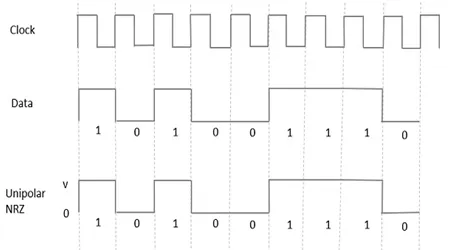
As shown, Unipolar NRZ uses a pulse with amplitude ‘V’ to represent a binary ‘1’ and no pulse to represent a binary ‘0’.
Unipolar RZ
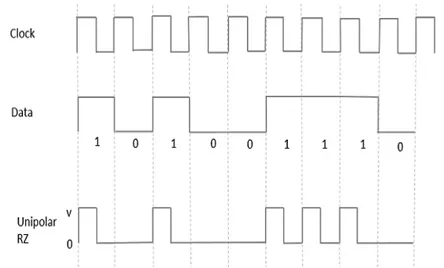
As shown, Unipolar RZ uses a pulse with a high-to-low transition to represent a binary ‘1’, and no pulse to represent a binary ‘0’. To map a binary one, the pulse initially remains high for the first half of the bit period and then returns to zero for the remaining half. In essence, the pulse returns to zero in the middle of the bit period.
Benefits or advantages of Unipolar Line Coding
- Simplicity: It’s a straightforward encoding technique, making it easy to implement.
- Unipolar NRZ - Less Bandwidth: Requires less bandwidth for transmission compared to some other methods.
- Unipolar RZ - Clock Signal: The spectral line present at the symbol rate can be used as a clock signal.
Drawbacks or disadvantages of Unipolar Line Coding
- DC Component: The average amplitude of a unipolar encoded signal is non-zero, creating a DC component. This DC component can shift the zero level of the signal, preventing it from traveling through certain mediums, such as microwave.
- Synchronization Issues: Unipolar encoding can lead to synchronization problems at the receiver when long strings of ones and zeros occur in the binary data. The lack of transitions in such data makes error detection and recovery more difficult.
- No Error Handling: It lacks any built-in error detection or correction mechanisms.
- Signal Droop: It’s susceptible to “Signal Droop” due to the presence of low-frequency components.
- Unipolar RZ Bandwidth: Unipolar RZ consumes twice the bandwidth compared to unipolar NRZ.
Summary
Unipolar line coding offers a simple digital encoding method but is generally less efficient than modern line coding techniques due to synchronization and transmission limitations.
Continue Learning Forward Error Correction (FEC) & Channel Coding
- Forward Error Correction: Advantages & Disadvantages
- Convolutional Encoder Example
- Turbo Encoder Basics
- CIRC Encoding vs Decoding
- Differential Encoder/Decoder Explained
Explore AI & Audio Coders
- Rotary Encoder: Basics and Types
- Understanding Vocoding and Vocoders
- Autoencoder Function in 6G Networks
Explore Data Encoding Techniques
- Encoding vs Modulation: Understanding the Difference
- Manchester vs Differential Manchester Encoding
- 4B/5B Encoding: Advantages & Disadvantages
- 8B/10B Encoding: Advantages & Disadvantages
- 64B/66B vs 8B/10B Encoding Comparison
- HDB3 Encoding: Advantages & Disadvantages
- MLT-3 Encoding: Advantages & Disadvantages
- R8ZS Encoding: Advantages & Disadvantages
- RZ, NRZ, CRZ, CSRZ Line Encoding Comparison