
What is Ultrasonic Sensor: Advantages and Disadvantages
Advertisement
An ultrasonic sensor is an electronic device that measures distance by transmitting and receiving high frequency sound waves. Its advantages include accurate non-contact distance measurement and reliable object detection, whereas its disadvantages include reduced performance on soft or irregular surfaces and sensitivity to environmental conditions.
Ultrasonic Sensor Working principle
An ultrasonic sensor is a device that uses ultrasonic sound waves to detect objects. “Ultrasonic” refers to sound waves with frequencies above 20 kHz, which are inaudible to humans.
An ultrasonic sensor typically consists of two main parts: a transmitter and a receiver.
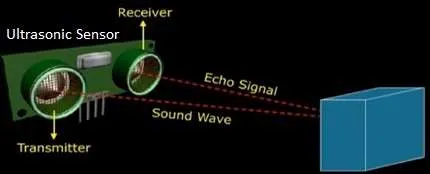 Figure-1 : Ultrasonic Sensor
The transmitter emits ultrasonic waves towards the target object. The receiver then detects the echo reflected from the object, allowing the sensor to determine the object’s distance. This functionality makes them a type of distance sensor. Ultrasonic sensors are used in a wide range of applications, including automatic doors, level control systems, anti-collision systems, and web break detection.
Benefits or Advantages of Ultrasonic Sensors
- Material Versatility: They can detect virtually all material types.
- Environmental Resistance: They are largely unaffected by dust, rain, snow, and other atmospheric conditions.
- Robust Operation: They are capable of operating in adverse environmental conditions.
- Longer Sensing Range: They offer a greater sensing distance (measured in centimeters and inches) compared to inductive or capacitive proximity sensors.
- Effective with Large, Hard Objects: They provide accurate readings when sensing large objects with hard, flat surfaces.
Drawbacks or Disadvantages of Ultrasonic Sensors
- Temperature Sensitivity: They are highly sensitive to temperature fluctuations, which can impact their accuracy.
- Difficulties with Certain Objects: They struggle to accurately detect reflections from soft, curved, thin, and small objects.
Summary
Ultrasonic sensors provide accurate, reliable and cost effective distance measurement for automation, robotics, automotive and industrial sensing applications.
Continue Learning Medical Ultrasound & Imaging
- Ultrasound : Key Applications & Benefits
- Ultrasound: Advantages and Disadvantages
- Ultrasound vs X-Ray Comparison
- Ultrasonic Diathermy: Advantages & Disadvantages
- Ultrasonic Sensor Construction and Working Principle
- Ultrasonic vs Infrared Sensors: Understanding the Differences