
What is Thread Protocol for IoT Home Automation: Advantages and Disadvantages
Advertisement
Thread is a low power, IPv6 based wireless mesh networking protocol designed for secure and reliable communication among smart home and IoT devices. Its advantages include self healing mesh networking, strong security, and energy efficiency, while its disadvantages include limited device compatibility, implementation complexity, and dependence on Thread certified ecosystems.
Introduction : Thread (802.15.4) is a low power, IP based wireless networking technology designed specifically for IoT devices. It’s known for its secure, scalable, and reliable connectivity, which makes it a great option for smart home automation systems. However, like any technology, Thread has its own set of benefits and limitations.
Thread Protocol in home automation : Key Features
Thread technology operates in the 2.4 GHz band, similar to Zigbee. It provides a secure mesh network for embedded, low-power, and low-cost devices. The Thread Group was formed in 2014 and now includes over 300 industry leaders across both consumer and industrial sectors.
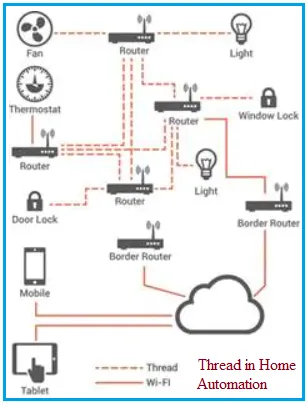
Thread network devices can access Wi-Fi through a router using the 6LoWPAN protocol, allowing them to communicate with each other. Initially designed for home automation, Thread is now also used in various industrial settings, such as street lighting and building automation.
Here are some key features of Thread wireless technology for home and building automation:
- Frequency Band: 2.4 GHz ISM
- Throughput: 250 Kbps
- Topology: Mesh
- Number of devices: 250 to 300
- One-hop range: Up to a few hundred meters; routers can extend the range through multi-hop configurations.
Thread protocol stack
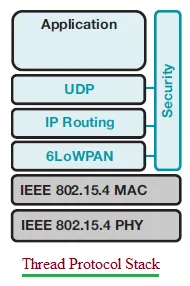
Figure 2 illustrates the Thread protocol layers as defined in IEEE 802.15.4 (PHY/MAC). In a Thread network, each node receives a 16-bit address that must be translated into an IP address using an application layer gateway. Cloud integration is achieved using a Thread border router. Network and mesh management is dynamic.
Benefits or Advantages of Thread Protocol for Smart Home Automation
- Thread devices are energy-efficient and can communicate with other devices over long distances, making them suitable for home and building automation.
- Thread devices can operate on a coin cell battery for several years.
- It’s ideal for device-to-device communication in many-to-one, one-to-many, and many-to-many configurations.
- Thread offers direct device addressability using IP addresses, eliminating any single point of failure.
- It employs AES-128 encryption and password-based authentication with DTLS (Datagram Transport Layer Security) to ensure secure connections between devices. Additionally, it uses authentication during the joining process with QR code scanning.
- Thread provides excellent latency and power performance for application packets.
- Unlike Zigbee, Thread doesn’t define specific application layers, making it a more flexible choice in terms of application layer selection.
- Thread networks are self-configuring and can automatically fix any routing issues that may occur.
- The Thread network is scalable, allowing it to expand from a basic star topology with a single router to a mesh topology when multiple routers are present.
- Thread topology uses redundant border routers, which increases reliability. This is particularly advantageous for larger commercial installations where system outages can have significant financial consequences.
Drawbacks or Disadvantages of Thread Protocol
- Native IPv6 addressing requires a router to convert from 802.15.4 to an additional IP interface.
- It doesn’t support very high data rates compared to Wi-Fi.
- It doesn’t offer the very long range provided by cellular wireless technologies.
- The maximum number of devices supported (approximately 250) is lower than that of Zigbee (approximately 65,560).
Summary
Thread has become an important communication protocol for smart homes by enabling secure, scalable, and energy efficient connectivity among connected devices. Its networking advantages improve reliability and interoperability within modern IoT ecosystems, although ecosystem support, deployment planning, and device compatibility influence successful implementation.
Continue Learning THREAD Technology
- What is Thread in IoT
- Thread Border Router vs Mesh Extender : Key differences
- Matter over Thread Architecture