
What is a speaker : 5 Advantages and Disadvantages
Advertisement
A speaker is an electroacoustic device that converts electrical audio signals into sound waves. Speakers are used in consumer electronics, communication systems, entertainment equipment, and public address systems. Advantages include real time audio output and ease of use, while disadvantages include sound distortion, power consumption, and performance limitations in noisy environments.
Loudspeakers, also called speakers, are an essential component of audio systems, converting electrical signals into sound waves to deliver music, dialogue, and other audio content. With a variety of types and technologies available, speakers enhance our listening experiences in homes, theaters, and public spaces.
Key Features & Construction of Speaker
The device which converts an electrical signal input to physical vibrations in the form of sound waves is known as a loudspeaker or speaker. It is an electromechanical device which is used in various applications right from hearing aids to air raid sirens.
It will produce more audible output compared to other identical speaker devices. The output depends on its construction and usage of applications. There are two main types of speakers viz. wired and wireless (Bluetooth, WiFi) based on its interface with the transmission medium. Loudspeakers may be divided into two main groups viz. cone type and horn type.
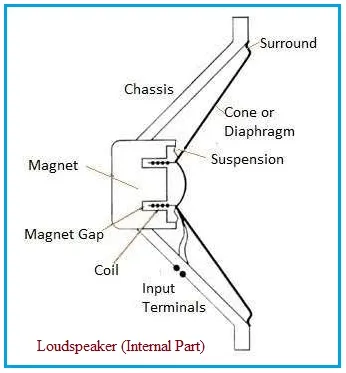
A speaker may also be categorized into diaphragm based and without it. Diaphragm based speakers include moving iron, piezoelectric, magnetostatic, magnetostrictive, electrostatic, ribbon, bending, flat panel, etc.
The speakers without a diaphragm include plasma arc, thermoacoustic and rotary woofers. There are speakers available based on digital technologies such as Bluetooth, WiFi, etc. Based on the input form, a speaker can either be an analog speaker or a digital speaker.
An analog speaker amplifies analog EM waves to sound waves. A digital speaker first converts a digital input to an analog input and then generates sound waves.
The sound produced by a loudspeaker depends on two parameters viz. amplitude (i.e. loudness) and frequency. Loudspeakers are used in outdoor places to address a larger audience during public meetings and presentations. Speakers are used in indoor places to address a few number of people.
Advantages of Speakers
- They are available in different sizes based on installation locations and applications.
- They are very easy to separate out from the main unit where a microphone is also connected.
- Speakers are used to produce high amplitude sound waves to cover a larger audience in a vast region.
- It is very easy to install, use and maintain without any training.
- Wireless speakers are much more comfortable to install without any hassles of wiring.
Disadvantages of Speakers
- They are bulky in size compared to normal indoor speakers.
- They need a large space.
- They are prone to interference from nearby radio equipment or other radio microphones.
- They consume large power due to their technical specifications.
- Wireless speakers have range limitations.
- They produce very large amplitude sound levels which are annoying for people in the closer vicinity.
Summary
Speakers convert electrical signals into audible sound for communication and entertainment. Advantages include convenient audio reproduction, while disadvantages include distortion, energy usage, and environmental noise sensitivity.