
Soft Tube Modulator vs. Hard Tube Modulator: Key Differences
Advertisement
This page compares Soft Tube Modulator and Hard Tube Modulator, highlighting the key differences between them.
Soft Tube Modulator
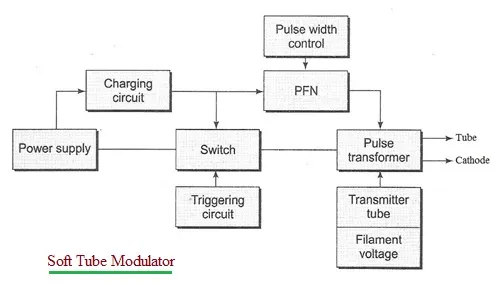
Figure 1 illustrates a Soft Tube Modulator. As shown, a power supply generates a high voltage. This voltage charges the Pulse Forming Network (PFN) through a charging circuit.
When the switch is in a short circuit condition, it initiates a pulse. If this condition terminates, the PFN discharges. The PFN acts as an energy storage device and transmits this energy to the transmitter. The duration of this transfer is governed by the PFN circuit. The initiation and termination of subsequent pulses occur during the following charging and discharging cycles of the PFN circuit.
Here are the key features of a soft tube modulator:
- It comprises a PFN, a switch pulse, a transformer, and a transmitter tube.
- It’s also known as a line modulator.
- The PFN is stimulated by a transmission line.
- It utilizes a Silicon Controlled Rectifier (SCR) for switching.
- Its pulse width is determined by the PFN.
Hard Tube Modulator
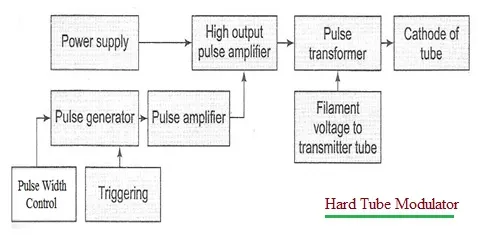
Figure 2 depicts a Hard Tube Modulator.
The following are characteristics of a hard tube modulator:
- It consists of a pulse generator, pulse amplifier, high output pulse amplifier, pulse transformer, power supply, transit trigger circuit, etc.
- It is a low-level modulator with added amplification.
- The desired pulse width is easily achievable.
- In the event of arc detection, the transmitter pulse shuts off immediately, protecting the transmitter.
- Once the arcs are extinguished, the modulator resumes normal operation.
- An example of a hard tube modulator is a floating deck configuration.
Continue Learning Modulation Types
- AM Vs. FM Vs. PM : Difference between Analog Modulation Techniques
- ASK Vs. FSK Vs. PSK : Difference between Digital Modulation Techniques
- PAM Vs. PWM Vs. PPM : Difference between Pulse Modulation Techniques
- BPSK Vs. QPSK : Key Differences
- 16-QAM Vs. 64-QAM Vs. 256-QAM : Key Differences
- 512-QAM Vs. 1024-QAM Vs. 2048-QAM Vs. 4096-QAM
- 4096QAM Modulation Used in Wi-Fi 7
- MSK Vs. GMSK : Modulation Technique used in GSM
- LORa Modulation Used in LoRaWAN
- 10% ASK & 100% ASK Modulation used in NFC
- OOK Vs. VPPM Vs. CSK : Visible Light Communication (VLC) Modulation Techniques
- QPSK Vs. OQPSK Vs. PI/4 QPSK
- PAM4 Modulation Used in Gigabit Ethernet
- CCK Vs. DSSS Vs. OFDM Used in WLAN (Wi-Fi) Standards