
What is a Magic Tee : Advantages and Disadvantages
Advertisement
A Magic Tee is a four port microwave waveguide junction that combines the characteristics of E-plane and H-plane tees. It is commonly used in radar, communication, and microwave measurement systems. Advantages include signal isolation and power division capabilities, while disadvantages include limited bandwidth and larger physical size compared to planar microwave components.
Magic Tee Structure and applications
The magic tee (also known as a magic-T or hybrid-tee) is a type of hybrid or 3-dB coupler. It’s essentially a combination of an E-plane tee and an H-plane tee.
As shown in Figure 1, Arm-4 forms the H-plane tee, while Arm-3 forms the E-plane Tee with Arm-1 and Arm-2. Arms 1 and 2 are called the side or collinear arms. Arm-3 is referred to as the “difference port,” and Arm-4 is called the “sum port.”
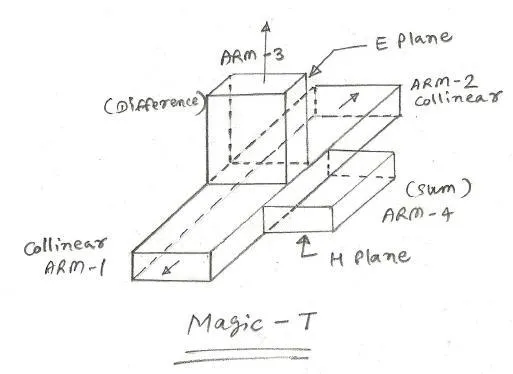
To function correctly, a magic tee should incorporate an internal matching structure. This structure typically consists of a post inside the H-plane tee and an inductive iris inside the E-plane limb.
Magic Tees are used in a wide variety of applications, such as:
- Bridges for impedance measurement
- Duplexers
- Power splitters
- Power combiners
- Mixers
- Circulators
Advantages of Magic Tee
Here are the benefits you can expect when using a Magic Tee:
-
Decoupled Output Ports: The output ports are decoupled from each other. This means the power delivered to one output port doesn’t depend on the termination at the other ports.
-
Perfectly Matched Output Ports: In a magic tee, the output ports are perfectly matched. Therefore, the power division between them doesn’t depend on the terminations connected to any of the magic tee’s ports. This is unlike E-plane and H-plane tees, where power division depends on terminations at the respective output ports.
-
Small Size: They can be made relatively compact.
-
Large Bandwidth: They can operate over a wide range of frequencies.
Disadvantages of Magic Tee
Here are some of the drawbacks associated with Magic Tees:
-
Reflections and Power Loss: When energy propagates through the arms of the magic tee, it can encounter reflections due to impedance mismatches at junctions. This leads to power loss.
-
Standing Waves and Arcing: Reflections can also cause the generation of standing waves, which, in turn, can lead to internal arcing. This limits the maximum power handling capability of the device.
-
Narrow and Close Lines: The internal lines within the magic tee can be very narrow and closely spaced.
Summary
A Magic Tee is a microwave junction used for signal combining and splitting. Advantages include excellent isolation and balanced operation, while disadvantages include bulkier construction and frequency-dependent performance.