
What is Sinuous Antenna: Advantages and Disadvantages
Advertisement
A sinuous antenna is a frequency independent planar antenna that provides broadband performance with dual polarization across a wide operating frequency range. Its advantages include wide bandwidth, stable radiation characteristics, and polarization diversity, whereas its disadvantages include complex geometry, fabrication challenges, and sophisticated feeding network requirements.
Sinuous Antenna Structure
The sinuous antenna is designed to achieve better performance compared to spiral antennas of the same size. It can sense both Right-Hand Circular Polarization (RHCP) and Left-Hand Circular Polarization (LHCP) simultaneously. This capability has earned it the name “Dual Polarized Sinuous Antenna.”
It’s a specific type of log-periodic antenna featuring two output ports. These ports provide maximum response to left-hand and right-hand circularly polarized signals. The antenna is also capable of responding to linearly polarized signals.
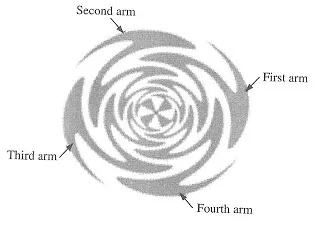
Due to its two-port design, it can always receive any polarized signal, with a sensitivity no less than 3 dB below the matched polarization sensitivity.
The antenna has four arms, rotated at 90 degrees to each other. These arms circularly oscillate +/- 45 degrees with increasing distance from the center. Sinuous antennas are gradually replacing spiral antennas and are used in anti-radiation missile systems and electronic warfare systems.
Benefits or Advantages of Sinuous Antenna
- Slant Polarization: Achieves 45-degree slant polarization without the need for a polarizer.
- Higher Bandwidth: Offers a higher bandwidth compared to other antenna types.
- Phased Array Applications: Very useful for phased focal plane array applications.
- Ease of Fabrication: Relatively easy to manufacture.
- UWB Applications: Wide range of advantages for Ultra-Wideband (UWB) applications.
Drawbacks or Disadvantages of Sinuous Antenna
- Complex Design and Fabrication : Sinuous antennas have intricate, self complementary geometries that require precise manufacturing. Fabrication becomes more challenging and expensive, especially at high frequencies (such as millimeter wave applications).
- Polarization and Pattern Variations : Although sinuous antennas can support dual or circular polarization over a wide bandwidth, their radiation pattern and polarization purity may vary with frequency. This can introduce beam squint, cross polarization, or gain fluctuations across the operating band.
- Need for a Balanced Feed and Balun : Sinuous antennas are balanced structures, while most RF systems use unbalanced (coaxial) feeds. A high quality balun or balanced feeding network is typically required, which increases design complexity, size, insertion loss, and overall cost.
Summary
Sinuous antennas are widely used in broadband communication, radar, electronic warfare, and radio astronomy because of their excellent frequency-independent performance. Their antenna advantages support versatile wireless systems, although design optimization and manufacturing precision remain critical engineering factors.
Continue Learning About Antenna Technology
- Antenna Basics Tutorial
- Antenna Related Terms
- Antenna mechanical Vs. electrical tilt
- Difference between antenna gain directivity efficiency
- Antenna gain & effective area
- Bandwidth Vs. beamwidth antenna difference
- Antenna Factor
- Near field Vs. Far field antenna radiation pattern
Explore Different Types of Antennas
-
Check-out: Guide to List of Antenna Types >>