
What is Satellite Phone: 5 Advantages and Disadvantages & Working
Advertisement
A satellite phone is a mobile communication device that connects directly to communication satellites instead of terrestrial cellular towers. Its advantages include reliable connectivity in remote regions and emergency situations, whereas its disadvantages include higher equipment costs, expensive service plans and reduced indoor signal availability.
Satellite Phone working operation
A satellite phone, also known as a sat phone, is a mobile communication device that enables communication via satellites orbiting the Earth. It allows users to make and receive calls, send and receive text messages, and access data services.
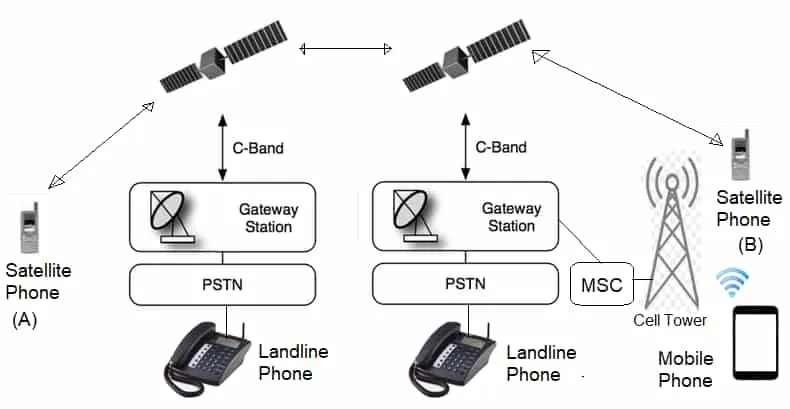
Unlike traditional phones that rely on terrestrial cell towers, satellite phones connect directly to satellites. These satellites relay signals to ground stations and then to the intended recipient. When both the caller and recipient use satellite phones, a direct connection can be established, bypassing the need for a ground station.
The diagram below illustrates various call scenarios for satellite phone users.
Satellite phones utilize L-band frequencies for communication with satellites. Specifically, they use:
- 1616 to 1626.5 MHz for uplink communication (phone to satellite)
- 1626.5 to 1660.5 MHz for downlink communication (satellite to phone)
Satellite phones require higher transmit power to effectively communicate with satellites in space, compensating for the increased path loss resulting from the long distance between the Earth and the satellite.
Key Satellite Communication Systems
Several satellite communication systems are designed to support satellite phones:
- Iridium: This system consists of 66 active satellites in Low Earth Orbit (LEO), providing complete global coverage, including the polar regions.
- Inmarsat: A British satellite telecommunications company, Inmarsat operates a global network of geostationary satellites. Initially focused on maritime and aviation communications, Inmarsat now supports satellite phones, offering voice, data, and broadband services in remote areas.
- GlobalStar: This system operates a constellation of 24 LEO satellites, supporting various communication services like two-way voice, data, and asset tracking.
- Thuraya: A regional satellite communication system covering parts of Europe, Africa, the Middle East, Central Asia, and Australia. Thuraya operates a constellation of LEO satellites, offering voice, data, and messaging services within its coverage area.
- OneWeb: A project aimed at deploying a large constellation of LEO satellites to provide global broadband internet services.
Benefits or Advantages of Satellite Phones
- Global Coverage: Satellite networks offer global coverage, connecting remote and isolated areas worldwide. They provide connectivity to areas not served by traditional cellular wireless networks, microwave point-to-point links, or wired networks like fiber optic or cable systems.
- Emergency Communication: Satellite phones are valuable in emergency situations, such as natural disasters, when other forms of communication are unavailable or have failed.
- Resilience: Satellite phone systems are more resilient during disasters because they are not dependent on local infrastructure.
- No Roaming Charges: Satellite phone users do not incur roaming charges when communicating across different countries or regions.
- Secure Communication: They offer secure and reliable communication for military personnel, government agencies, and organizations operating in remote areas.
- Rapid Deployment: Satellite phones and VSAT phones can be quickly deployed in emergency situations like wars and disasters.
Drawbacks or Disadvantages of Satellite Phones
- Line of Sight Requirement: Satellite phones require an unobstructed view of the sky to connect with satellites, making communication challenging in dense urban areas and indoor locations.
- Latency and Call Setup Time: Satellite phones experience longer call setup times and higher latency, requiring users to adjust to the communication delay.
- Battery Life: Satellite phones typically have shorter battery life due to the high transmit power requirements of satellite communication.
- Data Speed: Data services on satellite phones offer slower speeds compared to other wired and wireless networks, making internet browsing more time-consuming.
- Bulkiness: Satellite phones are generally bulkier and heavier than mobile phones due to the need for larger batteries and antennas.
Summary
Satellite phones provide dependable communication where conventional cellular networks are unavailable, supporting emergency response, maritime operations, aviation, and remote exploration. Their communication advantages ensure global accessibility, although equipment costs and operating expenses influence practical adoption.
Continue Learning Satellite Communication Technology
- Satellite Communication Basics Tutorial
- GEO Vs. LEO Vs. MEO Satellite Types
- Apogee and Perigee in Satellite Communication
- Satellite Capacity Allocation Types
- Satellite Frequency Bands
- Satellite Transponder Components & its function
- Satellite Bus vs Payload : Understand functions
- Satellite Ground Station Basics
- Satellite System Security Mechanisms & Standards
- Satellite Parking Lot Concepts and Procedures
- Satellite Launching Procedure and Processes
- Telemetry, Tracking and Command (TTC) in Satellite System