
What is RF Power Amplifier: 5 Advantages and Disadvantages
Advertisement
An RF power amplifier is an electronic device that increases the power level of radio frequency signals before transmission through an antenna. Its advantages include extended communication range and stronger signal transmission, while its disadvantages include reduced efficiency, heat generation, and possible signal distortion at high output power.
Introduction
An amplifier is an electronic device designed to increase the magnitude of current, voltage, or power of an input signal. Power amplifiers are used to drive various output types, and are broadly classified into audio, RF, and DC power amplifiers.
- Audio Power Amplifiers (PA): Used to increase the magnitude of audio signals, commonly found in speakers of mobile phones and televisions.
- DC Power Amplifiers: Used to increase the power of Pulse Width Modulated (PWM) signals. They take input from microcontrollers and provide an amplified output to DC motors (or actuators).
Power amplifiers operate in various classes, including A, B, AB, and C. They are used in a wide array of applications in consumer electronics, industrial systems, and wireless communications.
Application Note of RF Power Amplifier & its Selection Guide
An RF power amplifier amplifies modulated radio frequency (RF) signals, allowing them to be transmitted over long distances using an antenna. It’s designed to handle complex modulated signals such as multi-level QAM and OFDM.
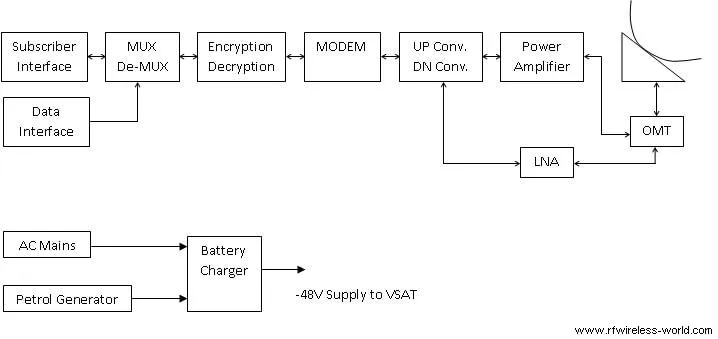
RF Power Amplifier in VSAT system
The figure above illustrates the position of an RF PA in a VSAT (Very Small Aperture Terminal) system used for satellite communication. It’s typically located after the up converter of the RF transceiver and before the RF antenna.
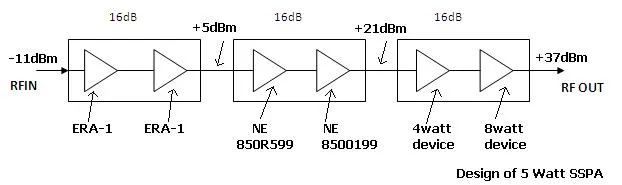
The figure above depicts internal design components of a 5 Watt RF power amplifier used in VSAT with gain of about 40 dB.
RF power amplifiers are manufactured by companies like Analog Devices, Empower RF Systems, Skyworks Solutions, ANADIGICS, and Agile Microwave Technology.
The following specifications are considered when selecting an RF Power Amplifier:
- Frequency range
- Power gain
- Power output at P1dB and saturated power output
- Gain response over the entire frequency range
- 1dB gain compression point
- Two-tone intermodulation
- VSWR (at input and output) or return loss
- Group delay, AM/PM conversion, Noise figure
- Other parameters: Size, power requirements, connectors, etc.
Benefits or Advantages of RF Power Amplifiers
- Increased Power: RF PAs increase the power of the input signal, enabling longer coverage by overcoming path loss and other system component losses.
- Enhanced Sensitivity: They improve the sensitivity of RF receivers.
- Improved SNR: RF PAs are used to improve the Signal-to-Noise Ratio (SNR) of the RF signal.
- High Linearity: They offer a high degree of linearity, minimizing distortion and ensuring the output signal closely resembles the amplified input signal.
- Power Efficiency: Power amplifiers with higher PAE (Power Added Efficiency) minimize power consumption and heat dissipation. PAE is calculated as follows:
- PAE (in %) = ((RF_Out_power - RF_In_Power) / (DC power)) x 100
Drawbacks or Disadvantages of RF Power Amplifiers
- Heat Dissipation: RF Power amplifiers with lower PAE have more heat dissipation and higher power consumption.
- Non-Linearity: Due to their non-linear behavior, RF PAs can produce harmonic frequencies and IMD (Intermodulation) products, potentially causing interference with other signals. This needs careful consideration during design.
- Saturation: RF PAs have a saturation region beyond which the output power cannot be increased further.
- Size and Bulk: RF PAs are often large and bulky, making them unsuitable for portable and mobile devices.
- Efficiency: RF PAs may not always have high efficiency, leading to increased heat dissipation and power consumption.
Summary
RF power amplifiers are indispensable in wireless communication, broadcasting, satellite, and radar systems because they provide the transmission power needed for reliable long distance communication. Their amplification advantages significantly improve coverage and signal strength, although efficiency, thermal management and linearity remain key design challenges.
Continue Learning Power Amplifiers (PA) & RF Amplifiers
- RF Amplifier Basics & Power Amplifier Design
- Class A vs Class B Amplifier
- Class G vs Class H Amplifiers
- SCPA vs MCPA Power Amplifiers