
What is RF Phase Shifter: 5 Advantages and Disadvantages
Advertisement
An RF phase shifter is a microwave component that changes the phase of a radio frequency signal without significantly altering its amplitude. Its advantages include precise beam steering and signal control, whereas its disadvantages include insertion loss, frequency sensitivity, and increased implementation complexity in broadband systems.
RF Phase Shifter operation & Selection Guide
Introduction: An RF phase shifter, as the name indicates, shifts the phase angle of an RF signal applied to its input. Critically, it does not alter the amplitude of the RF signal. There are various types of RF phase shifters tailored to specific requirements, including analog, digital, and mechanical phase shifters.
The figure below illustrates a major application of RF phase shifters: phased array antenna systems. In these systems, the phase of the signal transmitted from multiple antennas is shifted by different angles to shape the beam according to requirements. This antenna array system is also referred to as MIMO (Multiple-Input Multiple-Output). It’s commonly employed in 4G/5G base stations and smartphones.
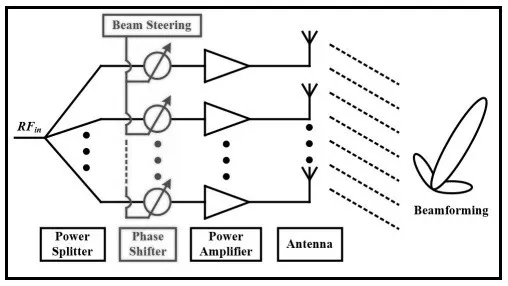 RF phase shifter for phased array antenna
The following mathematical equation can be used to simulate phase shift and other parameters:
X(t) = A * cos(2πf_c*t + θ)
Where:
- X(t) is the baseband input signal
- A is the amplitude of the baseband signal
- f_c is the RF carrier frequency
- t is the time samples
- θ is the phase shift introduced by the RF phase shifter device.
The following specifications are typically considered when selecting an RF Phase Shifter:
- Control interface (analog, digital, or mechanical)
- Phase angle (degrees)
- Insertion loss (dB)
- Frequency range of operation
- Switching speed
- Power (Input/Output)
- VSWR (Voltage Standing Wave Ratio) or return loss
- Linearity (Degree to which phase shift is linear with respect to voltage/current)
- Supply voltage
- Package type, connector types, size, cost, etc.
Benefits or Advantages of RF Phase Shifters
- Allows precise control of RF signal propagation by changing the phase of the RF signal.
- Controls the direction of the beam transmitted by an antenna, thereby improving signal strength in a specific direction and reducing interference from other systems.
- Used in MIMO antenna array systems to create multiple paths or beams, which helps to improve system capacity and, consequently, data rate.
- Creates multiple signal paths, improving the system’s immunity against jamming.
- Used in antenna diversity systems to improve signal quality and reduce fading.
- Can be controlled remotely, which is very useful where physical tuning of the phase is not feasible.
- Offers low insertion loss, meaning the signal amplitude is not significantly affected.
Drawbacks or Disadvantages of RF Phase Shifters
- Often designed to operate over a narrow frequency band.
- Support a limited phase shift range.
- Have limited linearity, affecting the accuracy of the phase shift.
- Require calibration for accurate phase shifting.
- Sensitive to temperature changes, which can affect performance.
Summary
RF phase shifters are essential for phased array antennas, radar, satellite communication, and beamforming applications because they provide accurate phase control for directional signal transmission. Their operational advantages improve wireless system performance, although design precision and bandwidth limitations remain critical engineering considerations.