
RF Isolator vs. Circulator: Key Differences in Microwave Systems
Advertisement
The primary difference between an RF isolator and an RF circulator lies in their port configuration and function. A circulator is a three port device that routes signals sequentially from one port to the next in a circular direction. An isolator is essentially a two port device (often a circulator with one port permanently terminated) designed specifically to block reverse power flow.
In the world of RF and microwave engineering, isolators and circulators are essential components used to manage signal flow in communication systems. They are both passive microwave devices made of ferrite material. While both devices are designed to control and direct RF signals, they serve different purposes and have unique working principles.
RF Isolator
An RF isolator is a 2-port device. It is unidirectional. It is mainly used to avoid reflections from its output to the input port, hence prevent damage to the device/component connected to its input port. As shown in the figure it can pass signal from port 1 to port 2.
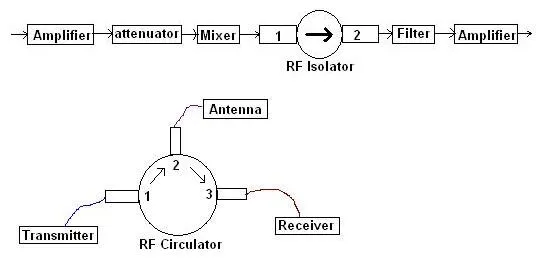
As shown, it allows RF signals to pass in one direction (i.e., from port-1 to port-2) while blocking them in the opposite direction (i.e., from port-2 to port-1). It offers isolation from port-2 to port-1 which prevents reflections from returning to the source side components.
RF Circulator
An RF circulator is a 3-port device. It is mainly used to make use of a single antenna between both the transmitter and receiver by connecting them appropriately at its ports. It can pass signal from (1 to 2)/(2 to 3)/(3 to 1) OR from (3 to 2)/(2 to 1)/(1 to 3) based on clockwise or anti-clockwise design. As shown, at port 1, the transmitter is connected, at port 2, the antenna, and at port-3, the receiver is connected.
If the RF circulator is a clockwise type, when the signal at port-1 is applied, which is from the transmitter, it is transmitted by the antenna. And when some signal is received by the antenna, it is directed to the receiver connected at port-3.
Difference between Isolator and Circulator
The following table compares RF isolators vs circulators in the Microwave domain and explores the comparison between them.
| Features | RF Isolator | RF Circulator |
|---|---|---|
| Function | Allows signal transmission in one direction while blocking in the opposite direction | Routes signals from one port to the next sequentially, providing isolation between ports |
| Number of ports | Two | Three |
| Isolation | High isolation between input and output ports | Provides isolation between ports, but typically lower between adjacent ports compared to input/output |
| Directionality | Unidirectional | Bidirectional in a specific direction |
| Complexity | Generally simpler | More complex |
| Cost | More affordable | May be costlier |
| Applications | Prevents signal reflections, used in RF amplifiers, mixers, antennas | Signal routing and isolation between multiple components, used in radar systems, RF test equipment, communication systems |
Conclusion
RF isolators and circulators play vital roles in ensuring efficient signal management in RF and microwave systems. While isolators are designed to allow unidirectional signal flow, circulators facilitate multi-port signal routing with minimal loss. Recognizing their differences in terms of design, functionality, and applications can guide you in selecting the right component for your specific needs. By leveraging these devices effectively, you can enhance the performance and reliability of your communication systems.
Continue Learning RF Circulators : Types & Use Cases
- RF Circulator Types, Functions, Design & Applications
- RF Circulator Selection Guide
- 4-Port vs 3-Port Circulator
- Branch vs Balanced vs Circulator Duplexers
- Cryogenic Circulator Benefits and Manufacturers
Continue Learning RF Isolators : Types & Use Cases
- RF Isolator Types, Functions & Design
- RF Isolator Selection Guide
- Microwave Isolators: Unidirectional Signal Transmission
- Cryogenic Isolator Benefits and Manufacturers