
What is RF Circulator: Advantages and Disadvantages
Advertisement
An RF circulator is a passive three-port or four-port microwave device that directs radio frequency signals sequentially from one port to the next while isolating unwanted signal paths. Its advantages include excellent port isolation and low insertion loss, while its disadvantages include limited operating bandwidth, higher cost, and sensitivity to frequency-specific design requirements.
RF Circulator : Construction, Function and Types
A circulator operates based on the non-reciprocal property of ferromagnetic materials. When such materials are placed in a DC magnetic field, electromagnetic wave propagation becomes non-reciprocal. It is a microwave passive device that allows uni-directional propagation of electromagnetic waves, similar to an isolator. It has many applications.
Figure 1 depicts one such application used to share a single common antenna between a transmitter and a receiver.
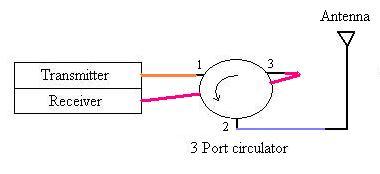
In this 3-port circulator, the signal travels in uni-directional mode, i.e., from port 1 to 2, and from 2 to 3, and so on. The reverse is not possible. This means a signal fed at the Nth port appears at the (N+1)th port, but not at the (N-1)th port.
As a result, the signal from the transmitter at port 1 can be transmitted via the antenna connected at port 2. Similarly, a signal received at port 2 can be fed to the receiver connected at port 3.
The following are the types of Circulators:
- Four-port circulator and Three-port circulator (based on the number of ports)
- Microstrip circulator
- Strip line circulator
- Waveguide circulator
Benefits or Advantages of Circulators
- It has many applications as it is a lossless and non-reciprocal device.
- The 3-port circulator can be used as an RF isolator by terminating one of its ports.
Drawbacks or Disadvantages of Circulators
- There is a limit on the power handling capability of the RF circulator. This can be increased by lowering impedance, increasing the intrinsic line width, or increasing substrate thickness.
- Insertion loss between coupled ports depends on various parameters such as copper loss of the strip and ground plane, dielectric loss of input/output strips, and magnetic loss of the ferrite disc. All these should be properly managed in order to achieve minimum insertion loss between the coupled ports.
Summary
RF circulators are essential components in radar, satellite, wireless communication, and test systems because they efficiently control signal flow while protecting sensitive equipment. Their operational benefits include improved isolation, reduced interference, and enhanced system reliability, although bandwidth limitations, material costs, and application-specific design constraints should be considered during system implementation.
Advertisement


