
What is a Photomultiplier Tube (PMT): 5 key Advantages and Disadvantages
Advertisement
A Photomultiplier Tube (PMT) is a highly sensitive light detector that converts extremely weak light into measurable electrical signals through photoemission and electron multiplication. It offers exceptional sensitivity, fast response time, and high gain, making it widely used in medical imaging, scientific research, nuclear instrumentation, and spectroscopy.
Key Features
- PMTs (Photomultiplier Tubes) are devices used for detecting very weak light signals.
- They are photo-emissive devices where the absorption of a photon leads to the emission of an electron.
- PMTs belong to the class of vacuum tubes, also known as vacuum phototubes.
- They are primarily used as visible range photon sensors.
- Early PMTs were larger, featuring glass vacuum envelopes. Modern PMTs are available in smaller sizes.
- While avalanche photodiodes are increasingly replacing PMTs, they are still used in diverse applications like Raman spectrophotometry, fluorescent molecular tagging, and single bubble sonoluminescence.
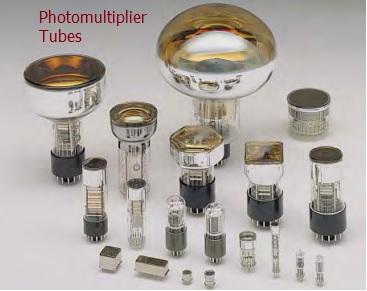
Advantages of Photomultiplier Tubes (PMT)
- Higher responsivity in A/W (Amps per Watt)
- Lower dark current
- High output Signal-to-Noise (S/N) ratio
- Low transport delay
- Wide spectral response
- High stability
Disadvantages of Photomultiplier Tubes (PMT)
- Mechanically fragile (due to their glass envelope).
- Limited shapes and sizes, and they can be physically large.
- Require stable, high-voltage power supplies.
- Expensive, often costing hundreds of dollars.
- Responsivity is affected by magnetic fields, necessitating magnetic shielding in sensitive applications.
- May require cooling to liquid nitrogen (LN2) temperatures for noise reduction in critical applications.
Summary
A Photomultiplier Tube (PMT) is an ultra-sensitive optical detector that amplifies weak light signals into electrical outputs using electron multiplication. It is widely used in scientific, medical, and radiation detection applications due to its high sensitivity and rapid response.
Advertisement


