
What is a Phototransistor: 5 Advantages and Disadvantages
By RF Wireless Expert Team
Advertisement
A phototransistor is a semiconductor device that detects light and amplifies the resulting electrical current, providing higher sensitivity than a photodiode. It is commonly used in optical switches, object detection, infrared receivers, and industrial automation where reliable light sensing is required.
Phototransistor Symbol and working operation
A phototransistor is essentially a transistor that’s controlled by light exposure. Think of it as a photodiode steering an ordinary bipolar transistor.
- It can be either a bipolar transistor or a field-effect transistor (FET).
- Its body is usually encased in resin, plastic, or a metal shell featuring a window to allow light in.
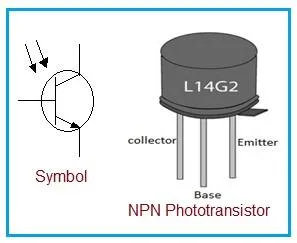
- A phototransistor typically has two leads, which connect internally to its collector and emitter (or source and drain in a FET). The base of the transistor (or the gate in a FET) reacts to light, regulating the current flow between the leads.
- Without light, a bipolar phototransistor allows a small leakage current between the collector and emitter, usually around 100 nA or less. However, when light hits it, it can conduct up to 50mA. This sets it apart from photodiodes, which can’t pass as much current.
- The figure above illustrates a common type of phototransistor: the Bipolar NPN.
- Examples: Optek/TT Electronics OP506A, Vishay TEKT5400S, Vishay BPW17N, and others.
Benefits or Advantages of Phototransistors
- Versatile Applications: Phototransistors are used in many applications, including light measurement, light-sensitive switches, and optocouplers.
- Higher Dark Current: The dark current (current flow when no light is present) is significantly higher in a phototransistor compared to a photodiode, which can be useful in some applications.
- Current Sinking Ability: They can sink current in the range of about 20 mA to 50 mA. Because of this, they can be hooked up to components with low impedance. For instance, a phototransistor can directly drive a piezoelectric audio transducer or an LED indicator, meaning it can interface directly with small loads.
- More Responsive to Light: Phototransistors are more sensitive to light than photoresistors.
- Cost-Effective: Phototransistors are typically more affordable than other light-sensing options.
- Voltage Generation: Phototransistors can produce a voltage that can be readily used with microcontrollers that have built-in Analog-to-Digital Converters (ADCs).
- Easily Obtainable Output Current: The output current from a phototransistor is easily measurable and usable in circuits.
Drawbacks or Disadvantages of Phototransistors
- Directional Sensitivity: Unlike photoresistors, which respond to light from almost any direction, phototransistors are only sensitive to light incident from a particular, narrow window.
- Voltage Limitations: Silicon phototransistors can’t handle high voltages above 1000V.
- Susceptibility to Surges and Radiation: They are more vulnerable to electrical surges/spikes and electromagnetic (EM) energy from radiation.
- Non-Linearity and Temperature Sensitivity: The characteristic response of a phototransistor is non-linear, and its performance is affected by temperature changes.
- Unit Variation: There can be significant variations in performance between individual phototransistor units.
Summary
A phototransistor is a light-sensitive transistor that converts optical signals into amplified electrical currents. It provides higher sensitivity than photodiodes and is widely used in optical sensing and switching applications.