
What is Fly-back Converter : Advantages and Disadvantages
Advertisement
A flyback converter is an isolated DC-DC power converter that stores energy in a transformer during the switch on period and releases it to the load during switch off. It is widely used in battery chargers, adapters, and low-power SMPS designs. Advantages include simple circuitry and electrical isolation, while disadvantages include lower efficiency and higher output ripple.
DC-DC Converter Features & Types
A DC-DC converter is an electronic circuit that modifies one voltage level to another. It’s essentially a voltage regulator comprised of switches, an inductor, and a capacitor for power conversion.
DC-DC converters are used in a variety of applications and can be categorized based on isolation between the input and output circuits:
- Isolated DC-DC Converter
- Non-isolated DC-DC Converter
Isolated DC-DC converters can be further divided into the following sub-types:
- Fly-back
- Forward
- Half bridge
- Full bridge
- Push Pull
Fly-back Converter Circuit and Working Operation
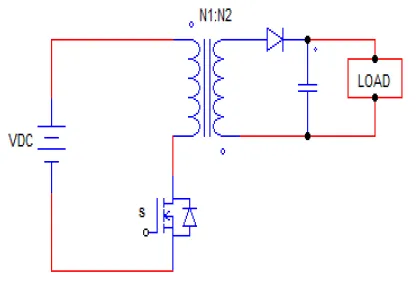 Figure-1 : flyback converter circuit
The flyback is essentially a buck-boost chopper with isolated sections achieved by using a transformer. The voltage ratio is multiplied with the additional advantage of isolation.
It’s utilized in both AC-to-DC and DC-to-DC conversions, providing galvanic isolation between the input and output. It can present single or multiple isolated output voltages and operates across a wide range of input voltage deviations.
Compared to other switched-mode power supply circuits, fly-back power supplies generally have lower efficiency. However, the technique is simple and relatively inexpensive, making it suitable for low output power ranges.
Typically, Fly-back converters offer efficiency in the range of 75% to 80%, with power ratings from 1 Watt to 50 Watts.
Advantages of Fly-back Converter
- The primary advantage is that the output filter inductors, which are essential for all forward topologies, are not necessary for the fly-back. This is because the transformer in the fly-back acts as an inductor, not purely as a transformer.
- In many cases, an LC filter is added to the load side of the fly-back regulator to reduce output voltage ripple.
- The voltage rating on secondary components is low.
Disadvantages of Fly-back Converter
- Higher EMI (Electromagnetic Interference) due to the air gap.
- Higher ripple current.
- Requires more output and input capacitance.
- Higher losses.
- Right half plane pole in the compensation loop, which can complicate control design.
Summary
Flyback converters are popular isolated power supplies for low and medium power applications. Advantages include simplicity, low cost, and multiple outputs, while disadvantages include limited efficiency and higher ripple compared to other converter topologies.