
L, S, C, X, Ku, K, Ka Frequency Bands: Advantages and Disadvantages
Advertisement
L, S, C, X, Ku, K, and Ka bands are microwave frequency ranges used in satellite communications, radar systems, wireless networks, and aerospace applications. Each band offers unique propagation characteristics, bandwidth, and coverage capabilities. Advantages vary in signal penetration and capacity, while disadvantages include atmospheric losses, interference, and spectrum limitations.
Here’s a visual representation of these frequency bands:
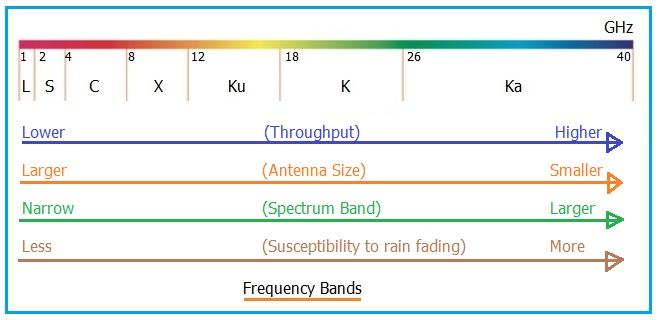
From the figure above, we can derive the following merits and demerits for each frequency band.
Advantages and Disadvantages of Each Band
L Band
Advantages:
- Less susceptible to rain fading.
- Cheaper equipment.
- Smaller antenna sizes.
Disadvantages:
- Very small bandwidth allocated for L-band in Inmarsat (1.3 to 1.7 GHz).
- Costly spectrum due to scarcity.
S Band
Advantages:
- Less susceptible to rain fading compared to Ku and Ka bands.
Disadvantages:
- Supports lower throughput.
- Narrow bandwidth.
- Larger antenna sizes.
C Band
Advantages:
- Wider and global coverage.
- Lower propagation delay.
- Less attenuation compared to other bands.
Disadvantages:
- Large antenna size.
- Lower throughput compared to other bands.
X Band
Advantages:
- Less interference from rain fading compared to higher frequency bands like Ku and Ka (rain fading is dominant above 10 GHz).
- Supports smaller antennas.
- Can handle higher power.
- Supports detection of smaller particles in radar applications.
- Lower cost equipment.
Disadvantages:
- More attenuation due to rain, snow, and ice.
- Limited clear air measurements in radar.
Ku Band
Advantages:
- Smaller antenna size.
- Provides wider beam coverage compared to other bands.
- Higher throughput compared to lower bands, though less than Ka band.
Disadvantages:
- Suffers from rain fading due to absorption of EM waves by water droplets (more than C band).
K Band
Advantages:
- Supports high throughput compared to Ku band.
- Supports smaller antennas compared to Ku band.
- Less susceptible to rain fading compared to Ka band.
Disadvantages:
- High atmospheric attenuation, unsuitable for long-distance communication.
- More susceptible to rain attenuation compared to Ku band.
Ka Band
Advantages:
- Provides high throughput beams.
- Delivers high bandwidth communication.
- Provides high power for transmission.
- Smaller equipment, easy to install and maintain.
- Transmits higher data over the same bandwidth compared to Ku band.
Disadvantages:
- Suffers from rain fading due to absorption of higher frequency EM waves by water droplets.
- Higher propagation delay due to double hop.
Summary
Microwave frequency bands from L to Ka serve diverse communication and radar applications. Their advantages include specialized performance characteristics, while disadvantages involve trade-offs in coverage, bandwidth, and weather sensitivity.
Advertisement

