
QPSK Modulation: Quadrature Phase Shift Keying Explained
Advertisement
This page provides an introduction to QPSK (Quadrature Phase Shift Keying) modulation. We’ll explore the basics of QPSK, highlight the differences between QPSK and BPSK (Binary Phase Shift Keying), and offer links to QPSK modulation MATLAB and Python code.
QPSK is a digital modulation technique known for its bandwidth efficiency. Each signal point in QPSK represents two bits of information. Unlike BPSK, which uses a 180-degree phase shift, QPSK employs phase shifts that are multiples of 90 degrees (π/2 radians).
QPSK Modulation Representation
Mathematically, QPSK modulation can be expressed as follows:
for input bits ‘11’
for input bits ‘01’
for input bits ‘00’
for input bits ‘10’
Here, represents the amplitude, is the carrier frequency, and is time.
QPSK Constellation Diagram
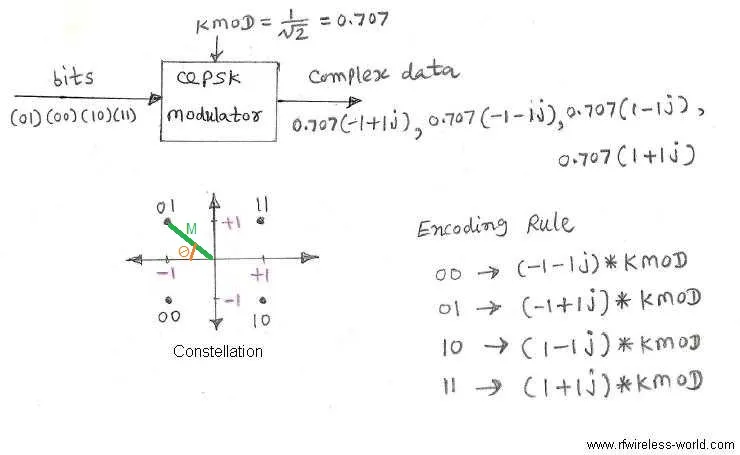
QPSK Figure showing constellation points and encoding rule (based on IEEE standard 802.16-2004).
The figure above illustrates the QPSK constellation diagram. It shows how two binary bits at the input are simultaneously converted into a complex signal (or ). This signal selects one of the four possible phases based on the input bit pair. Each state of the complex signal is called a “symbol.”
In QPSK, the input bit stream is divided into pairs of bits. These two bits are then fed into the QPSK modulator. For example, as shown in the constellation diagram, an input of ‘11’ results in an output of , where is a normalization factor. In many systems, is set to 0.707. This output, , is the symbol representing the two binary input bits.
QPSK Modulation Applications
QPSK finds use in numerous wireless communication standards, including:
- GSM (Global System for Mobile Communications)
- CDMA (Code Division Multiple Access)
- LTE (Long-Term Evolution)
- 802.11 WLAN (Wireless Local Area Network)
- 802.16 fixed and mobile WiMAX (Worldwide Interoperability for Microwave Access)
- Satellite communications
- Cable TV
QPSK’s benefits stem from the 90-degree separation between constellation points. This provides robustness compared to many other modulation techniques (except BPSK). Moreover, QPSK offers double the data rate carrying capacity of BPSK because each symbol maps to two bits. In contrast, BPSK maps only one bit per symbol.
Continue Learning Modulation Types
- AM Vs. FM Vs. PM : Difference between Analog Modulation Techniques
- ASK Vs. FSK Vs. PSK : Difference between Digital Modulation Techniques
- PAM Vs. PWM Vs. PPM : Difference between Pulse Modulation Techniques
- BPSK Vs. QPSK : Key Differences
- 16-QAM Vs. 64-QAM Vs. 256-QAM : Key Differences
- 512-QAM Vs. 1024-QAM Vs. 2048-QAM Vs. 4096-QAM
- 4096QAM Modulation Used in Wi-Fi 7
- MSK Vs. GMSK : Modulation Technique used in GSM
- LORa Modulation Used in LoRaWAN
- 10% ASK & 100% ASK Modulation used in NFC
- OOK Vs. VPPM Vs. CSK : Visible Light Communication (VLC) Modulation Techniques
- QPSK Vs. OQPSK Vs. PI/4 QPSK
- PAM4 Modulation Used in Gigabit Ethernet
- CCK Vs. DSSS Vs. OFDM Used in WLAN (Wi-Fi) Standards