
What is a Photoresistor : 5 Advantages and Disadvantages
Advertisement
A photoresistor, also known as a light-dependent resistor (LDR), is a passive sensor whose resistance changes according to the intensity of incident light. It is widely used in automatic lighting, light meters, security systems, and electronic control circuits because of its simple design and low cost.
Photoresistor Structure and circuit operation
- A photoresistor is a passive component whose resistance changes in response to light.
- It’s typically a disc-shaped component with two leads, as illustrated in Figure 1.
- When light strikes the disc’s surface, the resistance between the leads decreases.
- In darkness, resistance can be as high as 10 MOhms, while in bright light, it can drop to as low as 500 Ohms.
- As a passive component, it has no polarity.
- It offers equal resistance in both directions, making it suitable for both AC and DC circuits.
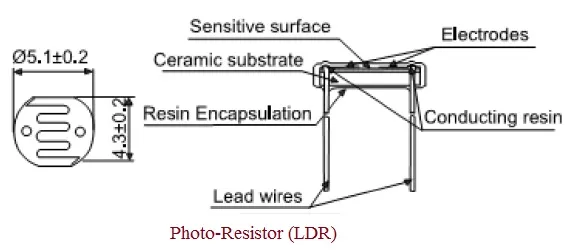
Photoresistor construction
One application of a photoresistor is demonstrated in the circuit below. In this scenario, it acts as a variable resistor based on the intensity of light falling upon it. As the incident light intensity increases, the resistance of the photoresistor decreases. This characteristic is known as photoconductivity.
Various circuit symbols represent the photoresistor. They are available in different sizes, ranging from smaller (5 mm in diameter) to larger (25 mm in diameter).
It can be used to generate variable voltage.
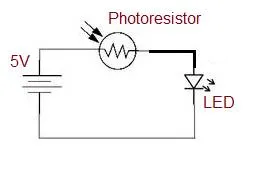
Photoresistor circuit
The term “photocell” was formerly used for photoresistors. Other names include photoconductive cell and LDR (Light Dependent Resistor).
Benefits or Advantages of Photoresistors
- It serves as a replacement for a variable resistor and is dependent on light. Its resistance decreases when light falls on it and increases in the dark.
- Photoresistors are inexpensive and come in various shapes and sizes.
- They operate with very little power and voltage.
- They can be used to simplify circuit designs.
- Being bi-directional, they can be connected in either direction.
Drawbacks or Disadvantages of Photoresistors
- Photoresistors are less sensitive to light compared to photodiodes or phototransistors.
- Cadmium sulfide, often used in photoresistor construction, is hazardous to the environment, limiting their availability to certain countries.
- Exceeding the rated maximum voltage, even for a short period, can cause irreversible damage.
- While inexpensive, they have a slow response time, typically in the range of tens or hundreds of milliseconds.
- They are temperature-sensitive and relatively bulky.
- They exhibit nonlinear characteristics.
Summary
A photoresistor (LDR) is a light-sensitive resistor whose resistance decreases as light intensity increases. It is commonly used in automatic lighting systems, light detection circuits, and environmental sensing applications.