
What is a Phased Array Antenna: 5 Advantages & Disadvantages
Advertisement
A phased array antenna is an advanced antenna system that electronically steers and shapes radio frequency (RF) beams without physically moving the antenna. By controlling the phase of signals across multiple antenna elements, it enables rapid beam steering, high gain, improved coverage and precise target tracking in radar, satellite communications, 5G networks and defense applications.
Structure and working of Phased Array Antennas
Traditional antennas, like parabolic reflectors, are often bulky and difficult to move in azimuth or elevation. Their movement relies on servo motors and actuators, which can be slow. Phased array antennas offer an alternative by using electronic means to steer the beam in the desired direction.
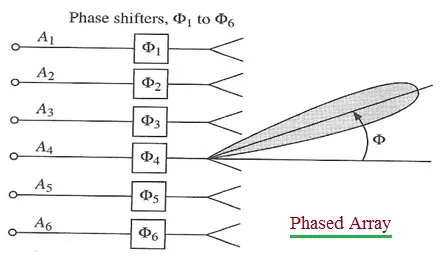 Figure 1 : Phased Array Antenna
To change the beam’s direction, the phase of the transmitting elements within the array is adjusted using a device called a phase shifter. Figure 1 illustrates a linear array composed of six antenna elements. Common antenna elements include dipoles, slots, and horns.
The beam’s angle relative to the antenna’s axis depends on:
- Operating wavelength of the signal
- Spacing between elements
- Phase shift between signals in the elements
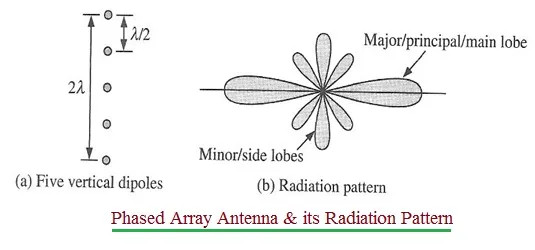 Figure 2 : Phased Array Antenna Radiation Pattern
The required number of antenna elements is determined by the desired directivity. Figure 2 shows the use of vertical dipoles in a phased array antenna, along with its radiation pattern. Horizontal dipoles can also be used.
Phased Array Antenna Arrangements
There are two primary arrangements for phased array antennas:
- Linear array: Elements are arranged in a line and fed from a common phase shifter.
- Planar array: Elements have their own phase shifters and are arranged in a matrix form.
Advantages of Phased Array Antennas
Here are the benefits of using phased array antennas:
- Higher Directivity: Increasing the number of elements in the array leads to higher directivity.
- Electronic Steering: Electronic steering eliminates the need for cumbersome mechanical steering using servo motors. This allows the beam to be moved in the desired direction in milliseconds.
- Radar Applications: Useful for surveillance and tracking in radar systems.
- Multiple Beams: Can emit multiple beams simultaneously for multifunction operations.
- Two Plane Steering: Planar array configurations allow beam steering in two planes. Digital beamforming is also possible.
- Simple Arrangement (Linear Array): Linear arrays have a relatively simple element arrangement.
Disadvantages of Phased Array Antennas
Here are the drawbacks of using phased array antennas:
- Limited Coverage: Coverage is limited to 120 degrees in both azimuth and elevation.
- Lower Frequency Agility: Can be challenging to achieve high frequency agility.
- Single Plane Deflection (Linear Array): Linear arrays only allow ray deflection in a single plane.
- Complex Planar Array: Planar array configurations are complex and require advanced electronic controls for the phase shifters.
- High Cost: Phased array antennas can be expensive.
Summary
A phased array antenna is a powerful RF technology that delivers electronic beam steering, fast response times, high reliability, and superior coverage compared to conventional antennas. While it offers significant advantages for radar, satellite, defense and 5G applications, factors such as higher cost, design complexity and power consumption must be considered in selection.