
PCIe over PCI: 5-10 Advantages and Disadvantages
Advertisement
PCI Express (PCIe) is the modern successor to the PCI bus, offering higher bandwidth, point-to-point communication, and improved scalability. Compared with PCI, PCIe delivers faster data transfer, lower latency, and better support for high-performance devices including graphics cards, SSDs, and networking equipment.
Key features of PCIe
- PCI-e or PCIe stands for Peripheral Component Interconnect Express.
- It is a high-speed serial computer expansion bus designed to replace PCI/PCI-X.
- As mentioned, PCI express is the successor to the traditional PCI interface used in desktop PCs.
- PCI express evolutions are PCIe 1.0, 2.0, 3.0, 4.0, 5.0 and 6.0 (planned).
- These versions support different raw data rates (or speeds) and bandwidths.
- It supports a maximum data rate of 32 GT/s and interconnect bandwidth of 32 Gb/s.
- It is a serial interface, unlike PCI, which was a parallel interface.
- PCI express supports more devices (~32) on each bus compared to PCI (~5).
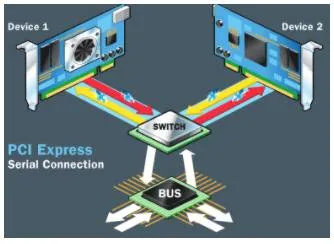
The PCIe interface supports hot plugging and uses a point to point or shared switch topology. The figure depicts the serial interface connection used by PCIe devices to communicate with the switch.
Benefits or Advantages of PCIe
- It is serial technology which provides scalable performance.
- It offers higher bandwidth and consecutively very fast speed.
- It is a point-to-point link dedicated to each device instead of the PCI shared bus.
- It offers lower delay or latency as it provides direct connectivity to chipsets.
- It supports isochronous data transfer.
- It supports advanced power management.
- It supports hot pluggability.
- It is backward compatible with conventional PCI.
- The higher bandwidth allows smaller form factors and a reduction in cost.
- Moreover, it is simple in board design and has fewer signal integrity issues.
- Embedded clocking enables easy speed changes as compared to sync clocking.
Drawbacks or Disadvantages of PCIe
- Bandwidth is not shared, unlike the PCI bus.
- PCIe SSDs consume more power when used for longer periods.
- Most older PCs do not support PCIe SSD.
- The PCIe bus carries different types of data, but it does not have any specification.
- It is expensive to buy an SSD drive.
Summary
PCI Express (PCIe) is an advanced replacement for the PCI bus, offering significantly higher bandwidth, lower latency, and scalable point-to-point communication. It is widely used for GPUs, SSDs, and high-speed networking devices.