 RF
RFWhat is Wireless M-Bus (wM-Bus)
Advertisement
Wireless M-Bus is a wireless communication standard developed for remote meter reading and utility monitoring applications. It enables secure and energy efficient data transmission between water, gas, heat and electricity meters and collection systems, supporting smart metering and advanced utility management infrastructure.
wM-Bus stands for Wireless Metering Bus. It is defined by the EN13757-4 standard, which specifies communication between meters and other system components, such as read out devices and data collectors. These devices can be either stationary or mobile.
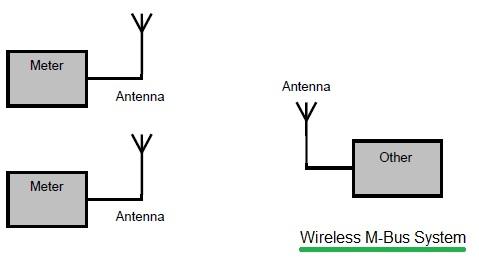
Figure: Wireless M-Bus communication system block diagram
The communication between the meter and other system components can be one-way or two-way.
wM-Bus PHY Modes
There are several physical layer (PHY) modes defined for wM-Bus. These modes are listed in the table below:
| WM-Bus PHY Mode | Description |
|---|---|
| S-Mode (Stationary Mode) | |
| S1-Mode (One way) | |
| S1m-Mode (One way) | |
| S2-Mode (two way) | |
| T-Mode (Frequent Transmit Mode) | |
| T1-Mode (one way) | |
| T2-Mode (two way) | |
| R-Mode (Frequent Receive Mode) | |
| R2-Mode (two way) | |
| N-Mode (Stationary Mode) | |
| N1 Mode (one way) | |
| N2 Mode (two way) | |
| N2g-Mode (two way) | |
| C-Mode (Frequent Transmit Mode) | |
| C1 Mode (one way) | |
| C2 Mode (two way) | |
| F-Mode (Frequent Transmit Mode) | |
| F1 Mode (one way) | |
| F2 Mode (two way) |
wM-Bus Frequency Bands
The following table outlines the wM-Bus modes and their corresponding SRD (Short Range Device) frequency bands:
| wM Bus Mode | SRD Frequency Band |
|---|---|
| S1-Mode, S2-Mode | 868 MHz |
| T1-Mode, T2-Mode | 868 MHz |
| C1-Mode, C2-Mode | 868 MHz |
| R2-Mode | 868 MHz |
| N1-Mode, N2-Mode | 169 MHz |
| F1-Mode, F2-Mode | 433 MHz |
Wireless M-Bus (wM-Bus) Kits
Several companies offer wM-Bus kits, including both hardware and software components:
-
TEXAS INSTRUMENTS: Their CC112x and CC120x series support Wireless M-Bus Transceiver functionalities and operate in the 868, 433, and 169MHz frequency bands. They are compliant with ETSI 300-220 V2.3.1.
-
RENESAS: They provide a wireless M-Bus protocol stack and a Wireless M-Bus interface board with the following features:
- Supports T1, S1, T2, S1-m, C1, S2, C2, N1, F2, and N2 modes as per EN 13757-4.
- Operates in the 169 and 868 MHz frequency bands.
- Offers protocol stack source code, data-link layer, and application layer software libraries.
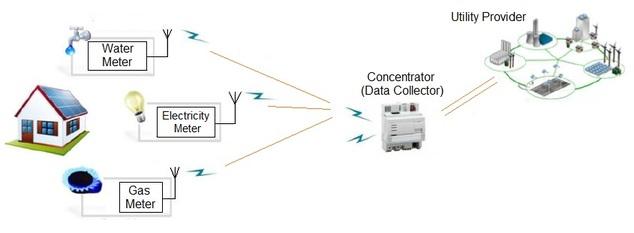
Figure: Wireless M-Bus network
Advertisement


