
What is Spacecraft Propulsion System: Advantages and Disadvantages
Advertisement
A spacecraft propulsion system generates thrust to launch, maneuver, and control spacecraft during space missions using chemical, electric, or advanced propulsion technologies. Its advantages include precise orbital control and mission flexibility, while its disadvantages include fuel limitations, engineering complexity, and high development costs.
Types of propulsion systems
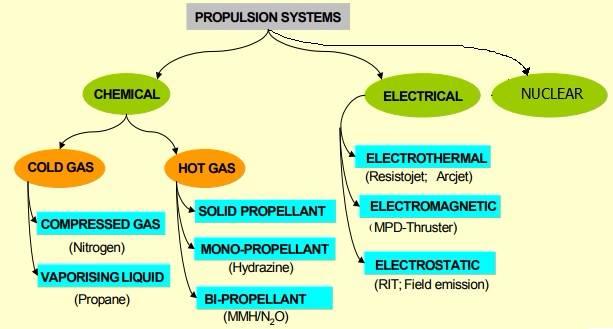
There are three main types of propulsion systems:
- Chemical Propulsion System: This system utilizes chemical energy to generate high-temperature, high-pressure gases, which then produce thrust.
- Electrical Propulsion System: This system relies on electrical energy to create thrust.
- Nuclear Propulsion System: This system employs nuclear energy to heat gases, subsequently generating thrust.
Advantages of Chemical Spacecraft Propulsion System (cold gas type)
- Simplicity and Reliability: These systems are known for their straightforward design, making them dependable.
- Low Cost: Compared to other propulsion methods, chemical systems are the most economical.
- Low Thrust and Impulse Bit Capability: Ideal for fine adjustments and attitude control.
- Lower Contamination: Exhaust gases cause less contamination on the spacecraft’s outer surface.
Disadvantages of Chemical Spacecraft Propulsion System
- Low Performance: A low specific impulse (ISP, around 950 Ns/Kg) and a low effective exhaust velocity (ISSP, about 70 Ns/Kg) result in a heavier overall system.
Advantages of Electrical Spacecraft Propulsion System
- Flexible Layout: Offers a highly adaptable design, leading to a potential 30% reduction in volume compared to mechanical drive systems.
- Load Diversity: Benefits from a single, centralized power generation source.
- Environmental Benefits: Reduces fuel consumption, potentially by 14,000 tons per year.
- Low Noise: Electric motors have inherently low vibration characteristics.
- Automation: Designed for high automation and self-monitoring capabilities.
- Low Emissions: Minimizes the release of pollutants.
- Flexibility in Space: Offers versatility for various mission requirements.
- Safety: Enhanced safety features.
- Redundancy: Incorporates backup systems for increased reliability.
Disadvantages of Electrical Spacecraft Propulsion System
- High Cost: These systems are generally more expensive than others.
- Lower Efficiency: Can be less efficient compared to some alternatives.
- Complexity: Involves more intricate equipment, making the system complex.
Advantages of Nuclear Spacecraft Propulsion System
- High Specific Impulse (Isp): Offers a significantly higher specific impulse, ranging from 2 to 10 times that of chemical systems.
- Low Specific Mass: Measured in Kg/KW, leading to a lighter overall system.
- High Power: Enables high thrust capabilities.
- Versatile Propellant Use: Compatible with a wide range of propellants.
- Reduced Radiation: Some missions can benefit from reduced radiation levels.
Disadvantages of Nuclear Spacecraft Propulsion System
- High Cost: Developing, installing, operating, and maintaining a nuclear reactor is extremely expensive.
- Social Issues: Concerns surrounding the use of nuclear technology in space.
- Shielding Requirements: Reactor plants require substantial shielding to mitigate radiation hazards.
- Low Readiness Level: Technology is still relatively immature compared to other options.
Summary
Spacecraft propulsion systems are fundamental to satellite deployment, deep-space exploration, and orbital maneuvering by providing controlled thrust and mission capability. Their technological advantages enable increasingly ambitious space missions, although propulsion efficiency, fuel constraints, and system reliability continue to influence spacecraft design.
Advertisement


