
Single Shot vs. Multi-Shot LiDAR: Pros, Cons & Differences
Advertisement
Introduction : This page describes Single shot and Multi shot LiDAR systems including their working principles, benefits and drawbacks and their specific use cases.
Single Shot LiDAR
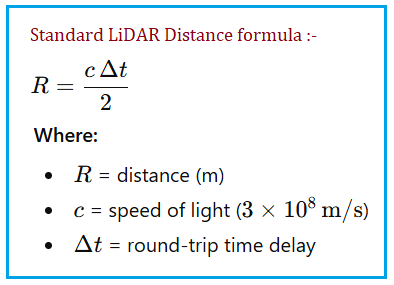
This type of LiDAR uses most straight form of distance measurement using direct time of flight (ToF) measurement. In this system, laser emitter fires single, discrete pulse of light toward target. A timer starts the moment the pulse is emitted and stops the moment the reflected echo is detected by the sensor. It the sensor detects return signal above a certain threshold, it records that timestamp as the distance. Following is the basic formula used by such LiDAR.
Benefits of single shot LiDAR
Following are pros or advantages of single shot LiDAR.
- Ideal for high speed applications because the distance is calculated instantly after one pulse.
- Requires minimal computational power; there is no complex data to analyze beyond a single timestamp.
- It has lower power consumption as the system is only active for the duration of a single pulse cycle.
Drawbacks of single shot LiDAR
Following are cons or disadvantages of single shot LiDAR.
- Highly susceptible to ambient light (solar noise) which can mask the signal.
- If the single pulse is absorbed or scattered by fog or a dark surface, no data is collected.
- To reach long distances with one shot, the pulse must be high power, which may risk exceeding “eye safety” limits.
Multi-Shot LiDAR
This LiDAR type fires rapid succession of low power pulses at the same coordinate. Instead of relying on one return, the system collects timestamps of all returns and plots them as histogram. Let us understand how it works.
- Ambient noise (e.g. sunlight) hits the sensor at random times, creating flat noise floor on histogram.
- Pulses reflected from actual target always return at the same time interval.
- After multiple shots, a distinct “peak” is observed on histogram plot.
- This indicates true distance of the object.
Benefits of Multi-Shot LiDAR
Following are pros or advantages of multi shot LiDAR.
- The multi-shot LiDAR uses statistics to filter out noise. Even if, the signal is weaker than sunlight, the repetition makes the signal visible.
- It can accurately detect objects in direct, mid-day sunlight due to high SNR (Signal to Noise Ratio).
- Uses multiple low-power pulses instead of one high-power pulse, making it easier to meet Class 1 safety standards.
- Can “see through” environmental obscurants like dust, steam or light rain by averaging out the noise.
Drawbacks of Multi-Shot LiDAR
Following are cons or disadvantages of multi shot LiDAR.
- It has increased latency as it takes more time to fire burst of pulses and accumulate data before distance can be determined.
- It has higher computational intensity as it requires FPGA or high speed processor to generate and analyze histograms in real time.
- It has higher system complexity, as it requires more sophisticated detectors (like SiPMs or SPADs) to count individual photons.
Comparison between Single Shot and Multi-Shot LiDAR
| Feature | Single Shot LiDAR | Multi-Shot LiDAR |
|---|---|---|
| Basic Principle | One Pulse and One measurement | Multiple pulses and one statistical peak |
| Noise resistance | Low, easily affected by solar noise | High, filters out noise using software algorithm by plotting histograms |
| Data processing | It is simple and based on threshold detection logic. | It is complex and based on plotting of histograms. |
| Speed or latency | Very fast, real time | Slightly slower, requires accumulation time. |
| Distance accuracy | High in dark, controlled settings | Extremely high in all lighting conditions |
| Safety | Requires high peak power for range. | Uses safe, low-power pulse bursts |
| Typical detectors | PIN diodes, APDs | SiPMs, SPADs (Photon Counting) |
| Best Use Case | Indoor industrial sensing, simple triggers | Automonomous driving, outdoor surveying, drones |
Summary
When choosing between the two, the decision usually comes down to the environment. For a controlled indoor environment (like a warehouse robot), Single shot is cost effective and fast. However, for any application that must work outdoors in the sun or through fog (like an autonomous car or a drone), Multi-shot is the industry standard due to its ability to distinguish signals from background noise.
Advertisement


