
What is PDMA (Polarisation Division Multiple Access)
Advertisement
PDMA is a wireless communication technique that enables multiple users to share the same frequency spectrum by utilizing different electromagnetic wave polarizations. By separating signals based on polarization states, PDMA improves spectral efficiency, increases network capacity, reduces interference and enhances performance in advanced wireless and 5G communication systems.
Over time, numerous multiple access techniques have been developed to allow multiple subscribers, users or clients to share common resources. These include FDMA, TDMA, CDMA, and OFDMA among others. PDMA (Polarisation Division Multiple Access) is another multiple access technique. It’s distinguishing feature is that it separates signals using different polarisation types of the antenna.
PDMA leverages vertical and horizontal polarisation, as illustrated below:
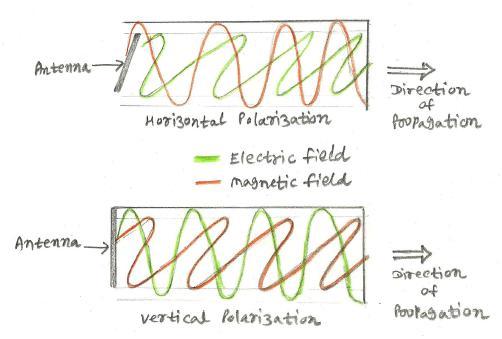
This approach allows two distinct signals to share the same frequency without causing interference, since each signal is transmitted with a different polarisation.
Applications of PDMA
Satellite communication systems commonly utilize PDMA. In fibre optic communication, DP-QPSK (Dual Polarisation Quadrature Phase Shift Keying) is used for multiplexing. This technique significantly increases data rates over a single fibre optic cable. To achieve these high speeds, the initial high-speed data stream is divided into slower streams, which are then vertically and horizontally polarised before transmission.
Advertisement


