
What is ASK Active Load Modulation in NFC
Advertisement
ASK (Amplitude Shift Keying) in NFC is a modulation technique where the amplitude of a carrier signal varies to represent digital information. It enables efficient data transfer between NFC devices, contactless payment systems, smart cards, access control solutions and short range wireless communication applications. Let us understand Active Load Modulation and its frequency spectrum.
Load modulation is utilized in NFC technology within the tag or transponder component. As illustrated in Figure 1, the transponder comprises an ASK modulator IC (housing logical AND gates), an amplifier, and an antenna. It includes a capacitor and resistor in parallel with the antenna.
ASK Modulator and Signal Generation
The ASK modulator, as shown in the image below, is employed to generate ASK active load modulation.
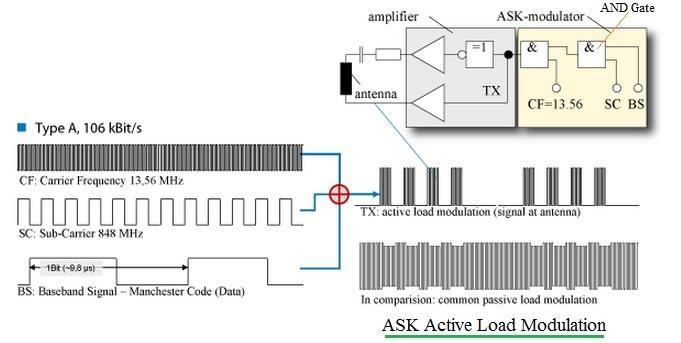
The inputs to the ASK modulator consist of the Carrier Frequency (CF) of 13.56 MHz, the Subcarrier frequency (SC) of 848 KHz, and the baseband Manchester coded signal. These signals are processed through AND gates, as depicted in Figure 1. This process generates a DSB (Double Side Band) signal, which is then amplified using an amplifier within the circuit.
Load Modulation Process
The amplified signal is then routed through the R/C combination, which is parallel to the antenna coil. When the resistor is engaged in the circuit, the current through the antenna increases. Conversely, when the capacitor is engaged, it alters the resonant frequency of the antenna circuit.
This process causes a change in the load on the antenna, resulting in a weakened signal. This weakened signal needs to be detected by the PCD demodulator. This method is therefore referred to as load modulation.
Frequency Spectrum of Load Modulation
The image below illustrates the frequency spectrum of load modulation.
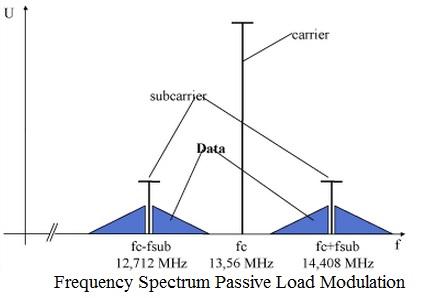
Figure 2 illustrates the RF frequency spectrum as observed at the reader. Passive load modulation comprises the RF carrier, two sidebands (at 12.712 MHz and 14.408 MHz), and modulated sidebands on these two subcarrier signals. All transmitted data is contained within the two sidebands. Therefore, the RF carrier of 13.56 MHz does not need to be transmitted by the transponder.
Advertisement


