
What are Neodymium Magnets: Advantages and Disadvantages
By RF Wireless Expert Team
Advertisement
Neodymium magnets are powerful rare earth permanent magnets made from neodymium, iron, and boron. They offer exceptional magnetic strength, compact size, and high efficiency in motors, generators, sensors, and electronic devices. However, they can be brittle, susceptible to corrosion, and may lose performance at elevated temperatures. Neodymium magnets are also known as NdFeB magnets (Neodymium Iron Boron).
Key features of Neodymium Magnet
- Neodymium magnets are a type of rare-earth magnet.
- They’re permanent magnets made from an alloy containing neodymium, iron, and boron.
- The alloy forms a Nd2Fe14B crystalline structure with a tetragonal shape.
- They are widely used in commercial products like electric motors, hard disk drives, door locks, loudspeakers, headphones, magnetic bearings, and MRI scanners.
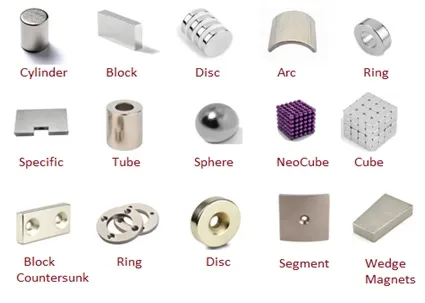
- This compound material was discovered by GM and Sumitomo Special Metals.
- The image above shows various shapes (cylinder, disc, block, tube, etc.) suitable for different applications.
- Other common magnets include Alnico (Aluminum Nickel Cobalt), Ferrite, Ceramic, Samarium Cobalt, and Magnetic Rubber.
Benefits or Advantages of Neodymium Magnets
- High Magnetic Field Strength: They possess a greater magnetic field strength compared to other types of magnets.
- Small Size & Various Shapes: They are available in small sizes and can be manufactured in various shapes to fit specific design requirements.
- Lightweight: They are relatively light in weight, making them suitable for applications where weight is a concern.
- Cost-Effective: They are less expensive compared to Samarium Cobalt magnets, offering a good balance of performance and cost.
- High Power-to-Weight Ratio: They offer a higher power-to-weight ratio compared to other magnet types, providing strong magnetic force in a compact package.
- High Resistance to Demagnetization: They exhibit high resistance to demagnetization, meaning they retain their magnetic properties for a longer period.
Drawbacks or Disadvantages of Neodymium Magnets
- Low Operating Temperature: They have a relatively low operating temperature, typically less than 80°C. Their magnetic characteristics start to decrease at 80°C and can be lost at higher temperatures.
- Low Corrosion Resistance: They offer lower corrosion resistance compared to some other magnet types, making them susceptible to rust in humid or corrosive environments.
- Brittle: They are brittle materials and can break or crack due to impacts or collisions.
Summary
Neodymium magnets deliver superior magnetic force and compact design for industrial, automotive, and consumer applications. Explore the advantages and disadvantages of neodymium magnets, including high strength, durability concerns, corrosion sensitivity, and temperature limitations.