
What is BPSK modulation : Advantages and Disadvantages
Advertisement
BPSK (Binary Phase Shift Keying) is a digital modulation technique that represents binary data using two distinct carrier phase states. It is widely used in satellite, wireless, and digital communication systems. Advantages include strong noise immunity and simple implementation, while disadvantages include lower spectral efficiency compared to advanced modulation schemes.
About BPSK
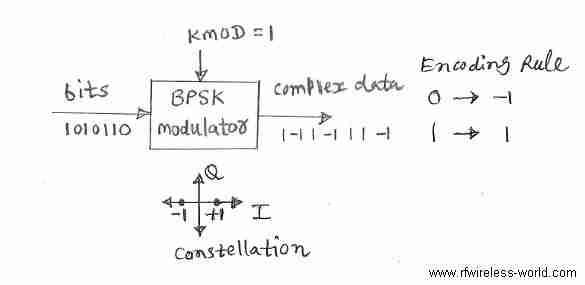
In BPSK modulation, binary data (1s and 0s) are represented by changes in the carrier’s phase by 180 degrees.
This concept is illustrated in the constellation diagram below:
 BPSK
BPSK
In BPSK modulation, each carrier transmits one single bit, so the symbol rate is equal to the bit rate. BPSK is considered power-efficient but not bandwidth-efficient.
Advantages of BPSK
- Robustness: BPSK is a very robust modulation technique because the binary 1 and 0 are separated by a 180-degree phase shift of the carrier. This means BPSK modulated data can travel longer distances when transmitted from base stations or subscriber stations, experiencing less interference.
- Pilot Signal Usage: BPSK modulation is often employed in pilot carriers and preamble sequences. These are used for time/frequency synchronization and channel estimation/equalization.
- Long-Distance Communication: Due to its robustness, BPSK modulation is used by many cellular towers for long-distance communication or data transmission.
- Simple Receiver Design: A BPSK demodulator only needs to make two decisions to recover the original binary information, making the BPSK receiver simpler compared to other modulation types.
- Power Efficiency: BPSK is a power-efficient modulation technique, as it requires less power to transmit the carrier with a relatively low number of bits.
Disadvantages of BPSK
- Low Data Rate: In BPSK modulation, one bit is carried by one analog carrier. Consequently, the data rate in bits per second is the same as the symbol rate.
- Not Bandwidth Efficient: The data rate is lower compared to other modulation techniques like QPSK (which is twice as efficient) and much lower than higher-order modulation techniques such as 16QAM and 64QAM. Therefore, BPSK is not a bandwidth-efficient modulation technique compared to others.
Summary
BPSK modulation transmits digital data using two carrier phase states. Advantages include reliability and noise resistance, while disadvantages include lower bandwidth efficiency.
Advertisement


