
What is BWO : Backward Wave Oscillator Advantages and Disadvantages
Advertisement
A Backward Wave Oscillator (BWO) is a microwave vacuum tube device that generates tunable high-frequency signals by interacting electron beams with slow-wave structures. It is used in radar, spectroscopy, and electronic warfare systems. Advantages include wide frequency tuning, while disadvantages include large size, high voltage requirements, and complexity.
Types and Structure of Backward Wave Oscillator
There are two main types of BWOs: O-type and M-type.
- O-Type BWO: Typically used as a low-power oscillator, delivering output in the range of a few hundred milliwatts over a frequency range of 1 to 15 GHz.
- M-Type BWO: Used to generate higher power outputs, reaching a few hundred watts at GHz frequencies.
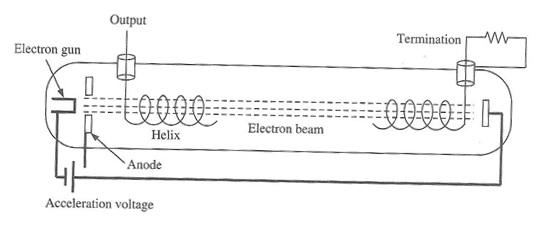
The fundamental working principle of a BWO is similar to that of a Traveling Wave Tube (TWT). Figure 1 (above) illustrates a typical BWO setup.
As shown, an O-type BWO incorporates components like an electron gun, a helix structure, and a collector plate.
- Electron Gun: Generates and accelerates a beam of electrons.
- Helix Structure: Facilitates the interaction between the electron beam and the weak RF signal that is to be amplified.
- Collector Plate: Collects the electrons after they have released their microwave energy.
Advantages of BWO (Backward Wave Oscillator)
-
Frequency Tuning: In folded waveguide BWOs, you can adjust the output frequency by varying the collector voltage. This is because the BWO’s frequency is governed by the transit time of the electron beam, and this transit time is, in turn, controlled by the collector potential. This makes them quite versatile.
-
Power Output Options: As mentioned earlier, O-type BWOs offer output power in the milliwatt range (1-15 GHz), while M-type BWOs can generate outputs in the hundred-watt range (at a few GHz). This allows you to select the BWO type that best suits your application’s power requirements.
Disadvantages of BWO (Backward Wave Oscillator)
-
Bandwidth Limitations: The fixed spacing of the folded waveguide in some BWO designs restricts the BWO’s overall bandwidth. This is particularly true for BWOs that use a folded transmission line between the cathode and the collector.
-
Lower Efficiency: BWOs generally exhibit lower efficiencies (around 20-30%) compared to other microwave tubes, such as TWTs and Klystrons.
Summary
A BWO (Backward Wave Oscillator) is a tunable microwave signal source used in scientific and defense applications. Advantages include broad frequency coverage, while disadvantages include high operating voltage, complexity, and larger physical size.
Tags
Advertisement


