
What is Infrared Sensor : 10 Advantages and Disadvantages
Advertisement
An infrared (IR) sensor detects infrared radiation emitted or reflected by objects and is widely used in motion detection, temperature measurement, automation, and security systems. It enables non-contact sensing in various environments. Advantages include low power consumption and fast response, while disadvantages include environmental sensitivity and limited range.
Key Features of Infrared Sensor
Following are some key characteristics of infrared waves.
- Frequency Range: 300 GHz to 400 THz
- Wavelength Range: 1 mm to 750 nm
- Sensing Range: 10 to 30 meters
- Data Rate: 300 to 115200 bps (Serial Infrared), 4 Mbps (Fast Infrared)
- Number of Devices: 2 in connection mode
- Modulation Type: Pulse Position Modulation
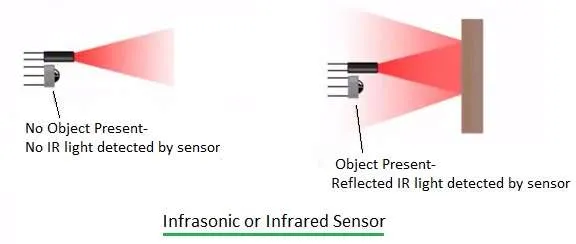 Infrared sensor
Infrared communication networks operate in two primary modes viz. point to point and diffuse.
Advantages of Infrared Sensors
- Secure Communication: Offers secure communication due to its line-of-sight or point-to-point communication mode.
- Low Power Consumption: Battery life is typically long in infrared devices because of their lower power consumption needs.
- Reliable Motion Detection: Infrared motion sensors reliably detect motion during both day and night.
- Non-Contact Sensing: The sensor doesn’t need to physically touch the object being sensed. This is particularly useful for targets closer than 10mm.
- Distance Measurement: Infrared devices can measure the distance to soft objects that might be difficult to detect with ultrasound.
- Small Size and Affordable: They are generally smaller in size and more cost-effective.
- Fast Response Time: Offers a quicker response time compared to thermocouples.
- Good Stability: Provides good stability over time.
- Resistant to Corrosion: Accuracy isn’t affected by corrosion or oxidation.
- High Repeatability: Delivers high repeatability in measurements.
Disadvantages of Infrared Sensors
- Susceptible to Obstructions: Infrared frequencies are affected by hard objects (walls, doors), smoke, dust, fog, and sunlight. This means they won’t work through walls or doors.
- Potential Eye Damage: High-power infrared waves can be harmful to the eyes.
- Limited Control Capabilities: In monitoring and control applications, it can only control one device at a time. Controlling objects not in the line of sight (LOS) is also difficult.
- Short Range: Supports a shorter range, and performance degrades over longer distances.
- Lower Data Rate: Supports lower data rate transmission compared to wired connections.
Summary
Infrared sensors detect heat and motion for automation and monitoring applications. Advantages include non-contact operation and energy efficiency, while disadvantages include interference from environmental conditions.
Continue Learning Infrared Technology
- Infrared Communication Basics (Tutorial)
- IrDA (Infrared Data Association): Advantages & Disadvantages
Explore Infrared Sensors & Detectors
- Infrared Sensors: Advantages and Disadvantages
- Active vs Passive Infrared Sensors
- Infrared Pyroelectric Detectors: Working & Applications
- Infrared NDIR (Non-Dispersive Infrared) Gas Sensor
Explore Infrared Thermometers & Measurement
- Handheld Infrared Thermometers: Advantages & Disadvantages
- Contact / Non-Contact Infrared Thermometer Manufacturers