
What is HSPA : Advantages and Disadvantages
By RF Wireless Expert Team
Advertisement
High Speed Packet Access (HSPA) is a mobile communication technology that combines HSDPA and HSUPA to enhance data transmission in UMTS networks. It enables faster internet access and improved mobile application performance. Advantages include increased upload and download speeds, while disadvantages include limited capacity compared to LTE and 5G technologies.
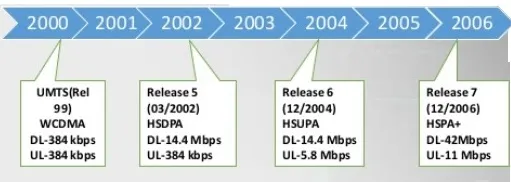
Key Features of HSPA
- HSPA stands for High-Speed Packet Access.
- It encompasses both HSDPA (High-Speed Downlink Packet Access) and HSUPA (High-Speed Uplink Packet Access).
- Standard: Defined in 3GPP release 5 (HSDPA) and release 6 (HSUPA) of the WCDMA specification.
- Network Components: An HSPA network consists of UE (User Equipment), Node B (base station), and RNC (Radio Network Controller).
- Data Rate: Offers 14.4/7.2 Mbps in the downlink and 5.76 Mbps in the uplink.
- Modulation: Utilizes QPSK/16QAM in HSDPA and QPSK in HSUPA.
- Evolved HSPA: HSPA+, an evolved version, follows 3GPP release 7.
- HSPA Development Phases:
Benefits or Advantages of HSPA
- Coherent Coverage: Provides reliable coverage, allowing users to seamlessly transition from outdoor to indoor environments while maintaining mobile data service.
- Lower Production Costs: More cost effective to produce compared to EDGE/UMTS.
- Normal Billing Rates: Users are billed based on standard mobile subscription rates, unlike WiFi services that may have different pricing models.
- Easy Connectivity: Connecting to HSPA is straightforward compared to WiFi, which requires scanning for available networks.
- Improved Performance with Indoor DAS: HSPA service integrated with an indoor Distributed Antenna System (DAS) can deliver better performance than WiFi.
- High Download and Upload Speeds: Offers download speeds of up to 14 Mbps and upload speeds of up to 5.8 Mbps.
- Low Latency: Provides low latency, typically below 50 milliseconds.
- HSPA+ Enhancements: The next generation of HSPA, HSPA+, supports even higher data rates through the use of MIMO (Multiple Input Multiple Output), advanced modulation schemes, and multi-carrier technology.
Drawbacks or Disadvantages of HSPA
- Bandwidth Limitation at Cell Edge: HSPA compliant UEs may not achieve the full bandwidth potential when located far from the Node B (base station).
- QoS Dependence on User Count: Quality of Service (QoS) in an HSPA network can be affected by the number of active users. More users can lead to reduced performance for each individual.
- Upgrade Costs: Upgrading both the network infrastructure and user equipment (UE) to support HSPA can be expensive.
Summary
HSPA enhances 3G mobile networks by improving data transmission rates. Advantages include faster connectivity and better efficiency, while disadvantages include lower capacity and performance than newer wireless standards.