
What is HSDPA : Advantages and Disadvantages
Advertisement
High Speed Downlink Packet Access (HSDPA) is an enhancement to UMTS 3G networks that improves downlink data rates and network efficiency. It supports faster mobile internet access, multimedia streaming, and web browsing. Advantages include higher data throughput and reduced latency, while disadvantages include network dependency and lower performance than LTE technologies.
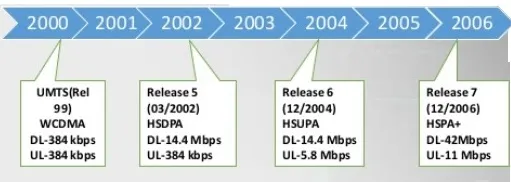
Figure 1: Development phases of HSPA.
Key Features of HSDPA
HSDPA is a high speed downlink data service designed to be deployed on existing 3G networks. It essentially boosts the download speeds of your 3G connection.
Key Features of HSDPA:
- 3GPP Standard: Release 5
- Direction: From network (Node-B) to Mobile Station (your phone)
- Data Rate: Up to 14.4 Mbps or 7.2 Mbps
- Modulation: QPSK, 16QAM
- Speed/Coverage Radius:
- Up to 480 Kbps at a range of up to 47 meters.
- Up to 10.7 Mbps at a range of up to 15 meters.
Benefits or Advantages of HSDPA
- Increased Radio Capacity: Offers better trunking gain, improving overall network capacity.
- High Downlink Data Load: Optimized for delivering a large amount of data to the user.
- Easy Deployment: Operators can easily deploy HSDPA on existing UMTS (3G) networks, making it cost-effective.
- Spectrum Efficiency: More efficient use of spectrum compared to older technologies like EDGE/UMTS, translating to more data per MHz.
- Higher Data Speeds: Supports speeds up to 14.4 Mbps in indoor DAS (Distributed Antenna System) environments.
- Competitive with WiFi: Mobile operators could compete with WiFi without needing a distributed network of access points, offering a more seamless mobile broadband experience.
Drawbacks or Disadvantages of HSDPA
- Increased Network Load: HSDPA puts a constant higher load on the 3G network, which can increase noise on existing UMTS channels and potentially degrade overall UMTS capacity for other users.
- No Soft Handover: Lack of soft handover means that overlapping pico-cells within a building could generate self-interference, potentially disrupting service.
- Downlink Focus: HSDPA only supports high-speed data on the downlink (download). For faster uploads, HSUPA (High Speed Uplink Packet Access) is required.
Summary
HSDPA improves 3G mobile broadband performance through higher data speeds. Advantages include better user experience and efficient spectrum use, while disadvantages include limited speeds compared to modern 4G and 5G networks.