
What is GPRS : Advantages and Disadvantages
By RF Wireless Expert Team
Advertisement
General Packet Radio Service (GPRS) is a packet-based mobile data technology introduced for GSM networks to support internet access and data communication. It enabled always on connectivity for mobile devices before 3G and 4G technologies. Advantages include wide coverage and low cost, while disadvantages include slow data rates and high latency.
Key Features of GPRS
GPRS is a 2.5G technology, sitting between 2G (GSM) and 3G (UMTS). It brings packet-switched data capabilities to mobile networks.
Here are some key features of GPRS:
- Uses 1 to 8 radio channels in the 200 kHz frequency band.
- Employs packet switching for data transfer.
- Suitable for voice and medium-speed data.
- Offers data speeds up to 171.2 Kbps.
- Extended GPRS (EGPRS or EDGE) boosts speeds up to 384 Kbps.
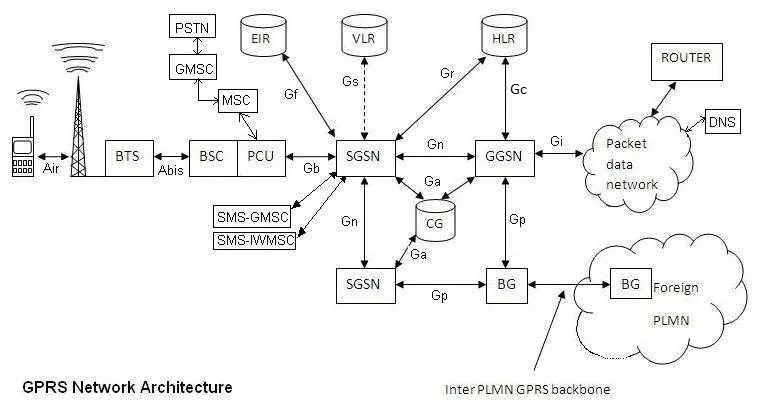 GPRS Network Architecture
Advantages of GPRS
- GSM Compatibility: GPRS reuses the same air interface elements as GSM (TDMA/FDMA, bursts, frame structure). It utilizes normal bursts and access bursts as defined by GSM. The frame structure is a single 52-frame multiframe (for both traffic and signalling) unlike GSM’s dual structure of 26-frame multiframe for traffic and 51-frame multiframe for signaling.
- Easy Deployment: Since GPRS builds upon existing GSM infrastructure, it’s relatively straightforward to deploy. Figure 1 illustrates the GPRS network architecture. The core network elements are the SGSN (Serving GPRS Support Node) and the GGSN (Gateway GPRS Support Node).
- Mobile Data Access: GPRS enables data services like web browsing and email on mobile devices without requiring broadband internet access. It offers seamless and instant connectivity to the internet.
- Usage-Based Billing: Users are charged only when data is sent or received. Furthermore, charges are based on the amount of data transferred, making it cost-effective.
- Widespread Availability: GPRS is available on almost all mobile devices, providing wireless internet access to a broad user base.
- Simultaneous Voice and Data: GPRS allows simultaneous use of both voice and data services. So, you can have a phone call while browsing the internet.
- Suitable for Low-Bandwidth Applications: The relatively lower data speeds of GPRS are ideal for applications that don’t require high bandwidth and prioritize privacy/security.
Disadvantages of GPRS
- Slow Data Rates: The data rates (171.2/384 Kbps) are considerably slower compared to modern wireless standards such as HSPA, LTE, and LTE-Advanced.
- Network Congestion: When many GPRS users in the same area utilize the service simultaneously, it can lead to congestion and slower data connection speeds.
- Limited Troubleshooting: Troubleshooting GPRS issues can be difficult. Typically, GPRS services are either working or not working, with limited intermediate diagnostic options.
Summary
GPRS introduced mobile packet data services for GSM networks. Advantages include affordable connectivity and extensive coverage, while disadvantages include limited speed and outdated performance.
Continue Learning GPRS Fundamentals & Architecture
- GPRS Tutorial: Comprehensive Overview
- GPRS Terminology Glossary
- GPRS Protocol Stack Overview
- GPRS Network Interfaces
- GPRS Key Features and Benefits
- GPRS Mobile Multislot Classes Explained
- Understanding GSM/GPRS RRC State Diagrams
Explore Technology Comparisons (GPRS Vs. Others)
- GSM vs GPRS: Understanding the Differences
- EDGE vs GPRS: What’s the Difference?
- GPS vs GPRS: Understanding the Difference