
What is Helical Antenna : Advantages and Disadvantages
Advertisement
A helical antenna consists of a conducting wire wound in a helix shape and is commonly used for satellite communication, GPS, and space applications. It can provide circular polarization and directional radiation. Advantages include wide bandwidth and good gain, while disadvantages include larger size and reduced performance at lower frequencies.
Helical Antenna Structure and modes
Introduction: A helical antenna utilizes a helix-shaped radiating element. These antennas are commonly used at VHF and UHF frequencies where circular polarization is desired.
The helix is typically supported by a ground plane, as illustrated below:
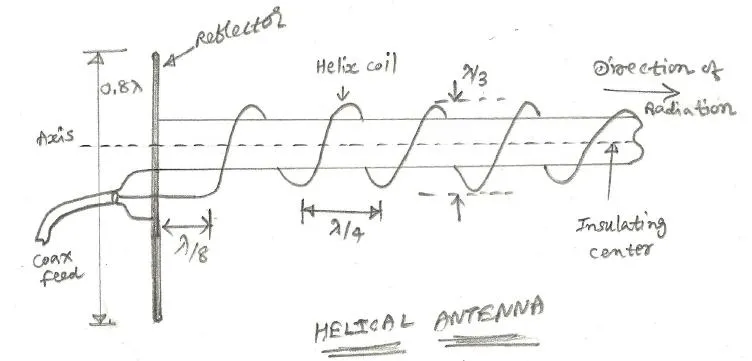
Helical antennas support two primary modes of radiation:
- Normal Mode: Radiation is perpendicular to the axis of the helix.
- Axial Mode: Radiation occurs in the axial direction (along the helix’s axis).
A helical antenna with circular polarization can effectively receive both horizontally and vertically polarized waves.
Applications of Helical Antennas
Helical antennas find use in various applications:
- Transmission and reception of VHF signals through the ionosphere.
- Satellite communications and radiometry applications.
- Communication between the Earth and the Moon.
Advantages (Benefits) of Helical Antennas
- Simple Design: Helical antennas are relatively straightforward to design and manufacture.
- Polarization Compatibility: Due to their circular polarization, they can effectively receive signals from both horizontal and vertical polarized antennas.
- Broadband Applications: They offer a wider bandwidth, making them suitable for broadband applications.
- HF/VHF Usage: Can be used for transmission and reception at HF/VHF frequencies.
- High Directivity: They offer higher directivity, focusing the signal in a specific direction.
- Robust Construction: Helical antennas are generally robust and durable.
Disadvantages (Drawbacks) of Helical Antennas
- Large Size: They tend to be large, requiring more space for installation.
- Decreased Efficiency with More Turns: As the number of turns increases, the efficiency decreases. Maximum efficiency (around 80%) is typically achieved with 3 to 4 turns.
- Higher Cost: They can be more expensive compared to some other antenna types.
Summary
Helical antennas are widely used for satellite and space communication systems. Advantages include circular polarization and broad bandwidth, while disadvantages include physical size constraints.
Continue Learning About Antenna Technology
- Antenna Basics Tutorial
- Antenna Related Terms
- Antenna mechanical Vs. electrical tilt
- Difference between antenna gain directivity efficiency
- Antenna gain & effective area
- Bandwidth Vs. beamwidth antenna difference
- Antenna Factor
- Near field Vs. Far field antenna radiation pattern
Explore Different Types of Antennas
-
Check-out: Guide to List of Antenna Types >>